
A Lesson in Humility and Indigeneity
Review of the exhibition Hyundai Commission: Máret Ánne Sara, 14.10.25 — 06.04.26 at Tate Modern, London

Through her large-scale installation at Tate Modern, Máret Ánne Sara delivers a powerful invitation to building a more sustainable future based on the concept of “geabbil”, the smart adaptability and flexibility that characterizes Indigenous philosophy.
Text by Marion Bouvier
This exhibition was commissioned by Tate Modern in partnership with the automobile South-Korean giant Hyundai, which is co-funding a series of exhibitions in the Turbine Hall until at least 2036. Máret Ánne Sara’s exhibition is the tenth iteration of the collaboration, and was curated by Helen O’Malley, with support of exhibition assistant Hannah Gorlizki. O’Malley has worked at Tate Modern, first as exhibition assistant, since 2013, and is currently Curator of International Art (Community & Participation); in this role, she has been influential in the “Tate Neighbours” initiative, and within the framework of the Hyundai Tate Research Centre, she is tasked to highlight non-Western and Indigenous artistic perspectives. O’Malley’s previous major contribution as curator was Abbas Zahedi: Begin Again (2022), which is itself part of Gathering Ground (2025), a group exhibition that brings together works from the Tate’s Collection and which, notably, also includes Sápmi’s artist superstar Outi Pieski.

Power, greed, and the smell of fear
Goavve-Geabbil is divided into two complementary works, which each occupy one half of the monumental Turbine Hall. The exhibition room is 152 meters long for 35 meters high, and used to house the electricity generators for the Bankside Power Station, producing electricity from coal until the 1950s, and later from burning oil until 1981. The conversion of the building into the Tate Modern we know today was completed in 2000, when it opened to the public. That specific history is the perfect “décor” for Sara’s first work on display, the towering Goavve.

Reaching out all the way from floor to ceiling, reindeer hides are imprisoned within electrical cables, and give out a smell akin to the scent reindeers give off when scared (“váivahuvvon hádja” in northern Sámi language). The smell itself was created by Mexican perfumer Nadjib Achaibou, and although subtle, it adds a multisensory, almost primal, experience of the exhibition. The work refers to the greediness of the extractive industry, and to the destructive consequences that increasing needs for electricity has had on traditional reindeer-herding grazing lands, and more generally, onto the Earth.
“Goavvi” is a Sámi term that can be translated to “locked pasture”. It evokes the number of reindeer that now frequently die because of the ecological crisis, a topic extensively developed in the audio sequences that can be heard in Geabbil (meaning “smartly adaptable”). As power-hungry forces shrink the land available for reindeer to graze, and reindeer starve as the lichen that constitutes their main source of food is trapped under an ice layer, Sara’s ladder of reindeer hides seem to imbue them back with spiritual power. Indeed, in Sámi cosmology before Christianization, shamans would regularly communicate with animals when entering trance, and forces of nature, stones as well as animals were revered. Although many of these beliefs have shrunk to the background in modern Sámi life, in large part due to colonization, spirituality is still very present in duodji, which is often roughly translated into “traditional Sámi craft” in English. Duodji is art-making, it is a philosophy of life that prioritizes careful and responsible use of resources, a worldview in which objects can be both useful, smartly designed, awe-inducing, and spiritually connecting its user or beholder to the beyond. With the use of the reindeer hides, as well as bones and skulls in Geabbil, Sara firmly anchors herself in duodji.

Indigenous science and the white man’s gaze
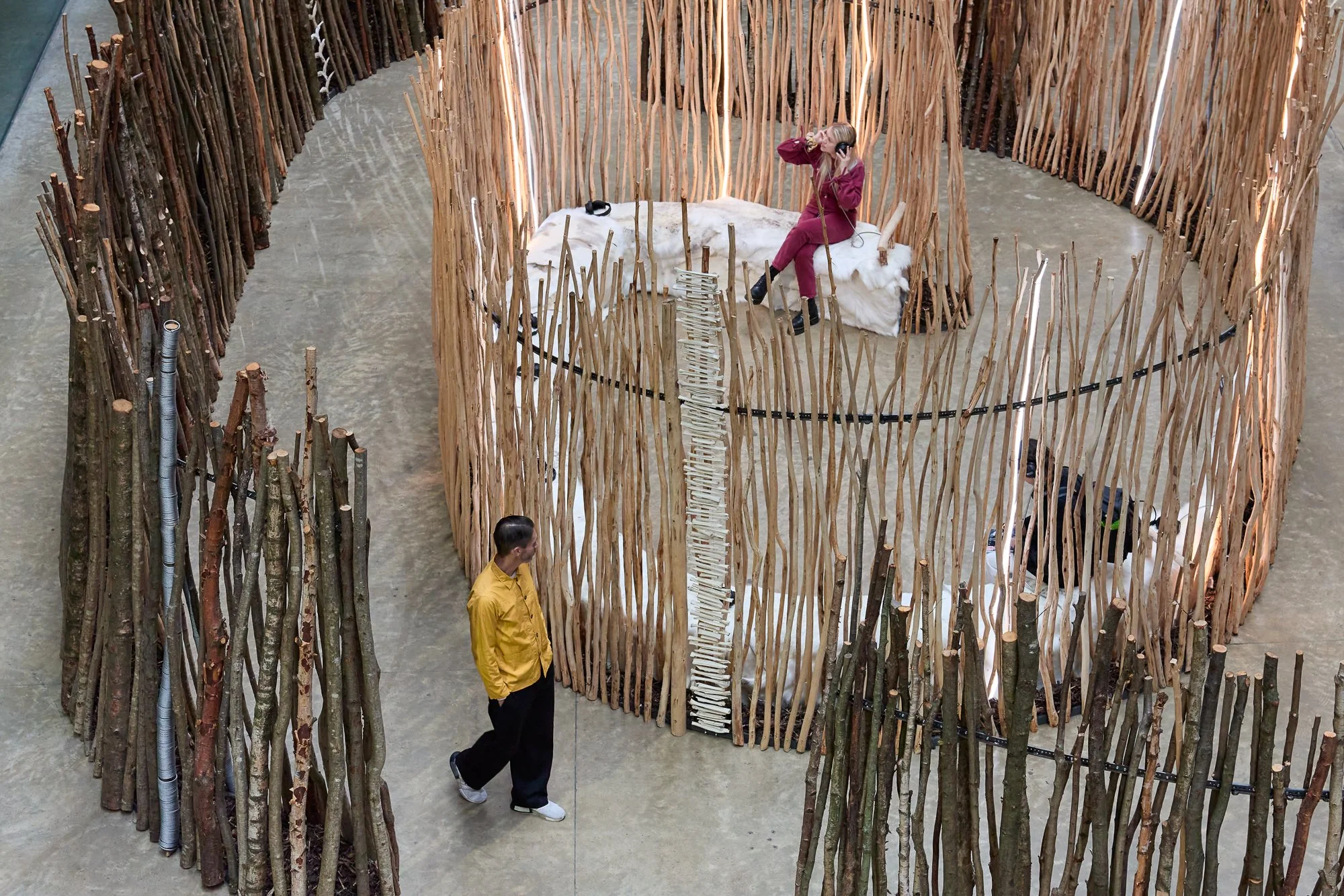
In Geabbil we dive further into the interplay between science, spirituality and art. This part of the installation reconstructs the inside of a reindeer nose on a massive scale, making me feel like a small bug that got breathed into the maze of the animal’s nasal cavities. The cartilage walls of the nose are here represented by fences made of birch trees peeled of their bark, and which also feature earmarks carvings; those are specific to each family and are used to identify the reindeer by their herders. Into each “cavity,” the visitors are invited to sit down on benches covered by reindeer hides, and to listen to 4 different audio segments, each about 20 minutes. It is both an anthropological account, with interviews of Ellán-Ánte Ánte, Asta Mitkijá Balto, Mari Boine, Máret Rávdná Buljo, as well as a poetic and political call for more attuned listening to our environment, and the need to rethink capitalist “science” and certitudes. This way the sound piece explores in depth the relationship of reindeer herders with their animals, the Sámi philosophy of adaptability and no-waste, careful use of resources, as well as current challenges induced by climate change.
At this point I need to address the Guardian’s review of the exhibition written by art critic Jonathan Jones. What a surprise it was – after experiencing the installation myself – to read this uninformed, sloppy, and sarcastic review, which, because it is published in the Guardian, has nonetheless automatically become a reference.

The whole review unfolds as a neo-colonial, white boy’s thoughts on Indigenous views of the world and approach to art. If Jones has ever set foot in Sápmi or other Indigenous lands and communities before, he has not learnt anything. There is not one mention of duodji in his piece, although this is a central concept in Sámi art and in Máret Ánne Sara’s artistic practice, as discussed earlier. Further, he criticizes Geabbil as being «a little fort of sticks to hide from the vastness” and describes the whole construction as “skimpy.” Sámi people do not build forts because they do not wage wars like Britain on its colonies, and the “skimpy” structure elaborately created by Sara actually pays homage to the ingenuity of many Indigenous constructions, which adapt to the demands of the local environment, to locally available materials, and yes, to use minimal resources not only to survive, but also to thrive, in a worldview defined by interrelationality. The “sticks” of Geabbil reminded me of the poles that are used to erect the Sámi lavvu, which has been the home of nomadic reindeer herders for centuries –a very efficient, clever and portable construction.

Finally, amongst the many other wince worthy statements one can read in that Guardian review, Jones also qualifies the reindeer hides that compose the backbone of Goavve as “washed and clean,” thus looking like “rugs.” Two sentences later, he writes negatively about “well-cleaned and neat arrangements of reindeer skulls and bones.” He sounds surprised that Sámi people wash and clean the things they use daily around in their lavvu and in their homes, to sit on their snowmobile or as decorative or artistic elements of their lives. Apparently it is not a “savage” enough representation of Indigenous people for Guardian’s art critic. Another quote penned by Jones gives me reasonable grounds to suspect this: “But why not confront us with this visually, physically? Butcher and serve reindeer meat perhaps. Just make it real. Somehow.”
Ah yes, slaughtering a reindeer in front of our eyes would suddenly make the climate change affecting the Arctic feel more real. It would be so much more real if we saw blood spurting out than if we were – as in this exhibition – invited to tread slowly and carefully, to be dwarfed within the shape of a reindeer’s nose, to listen to testimonies of reindeer herders and elders, as well as to sounds and songs that truly echo Sámi realities! Thanks for the tip, Jones. In fact, Sara’s earlier works have shown us that she is very much capable of summoning brutality and blood in her work when it is relevant. An example can be seen in Pile O’Sápmi (2016), her iconic piece that featured 200 (unwashed!) reindeer heads piled in front of the Finnmark District Court. The work was created in reaction to the trial that opposed her brother to the Norwegian government that had requested him to cull the major part of his herd on the ground of “overgrazing.”
However, Goavve-Geabbil is not about protesting an unjust decision or documenting the violence that this judicial decision represented for the Sara family. In its unimposing way, the installation invites the visitors at Tate Modern into a slower-paced world, into centuries of adaptation and dialogue with nature, into the symbiotic relationship between reindeer herders and the animals they live with. More importantly, Goavve-Geabbil carries a vital urgency to convey the destruction wrought by climate change, greed, and the disconnect between people and their environment.