The Betrayal of Structural Integrity
Review of Thora Dolven Balke: Bunnløs, NŌUA, 07.06. - 19.06.2026, Bodø
Thora Dolven Balke’s exhibition Bunnløs succeeds most when it embraces the formlessness of its subject matter rather than actively trying to construct it.
Text by Eso Malflor
To experience vertigo is to feel the sudden, terrifying failure of one’s own internal compass. It is a sensory betrayal where the stability of the world slips away, and the ability to distinguish between up and down is shattered. In Bunnløs at NŌUA, Thora Dolven Balke takes on the challenge of translating this profoundly disorienting phenomenon into physical form. The exhibition showcases two new large-scale works — a photographic collage on glass and a sculptural installation incorporating light and sound — that are directly inspired by this experience.
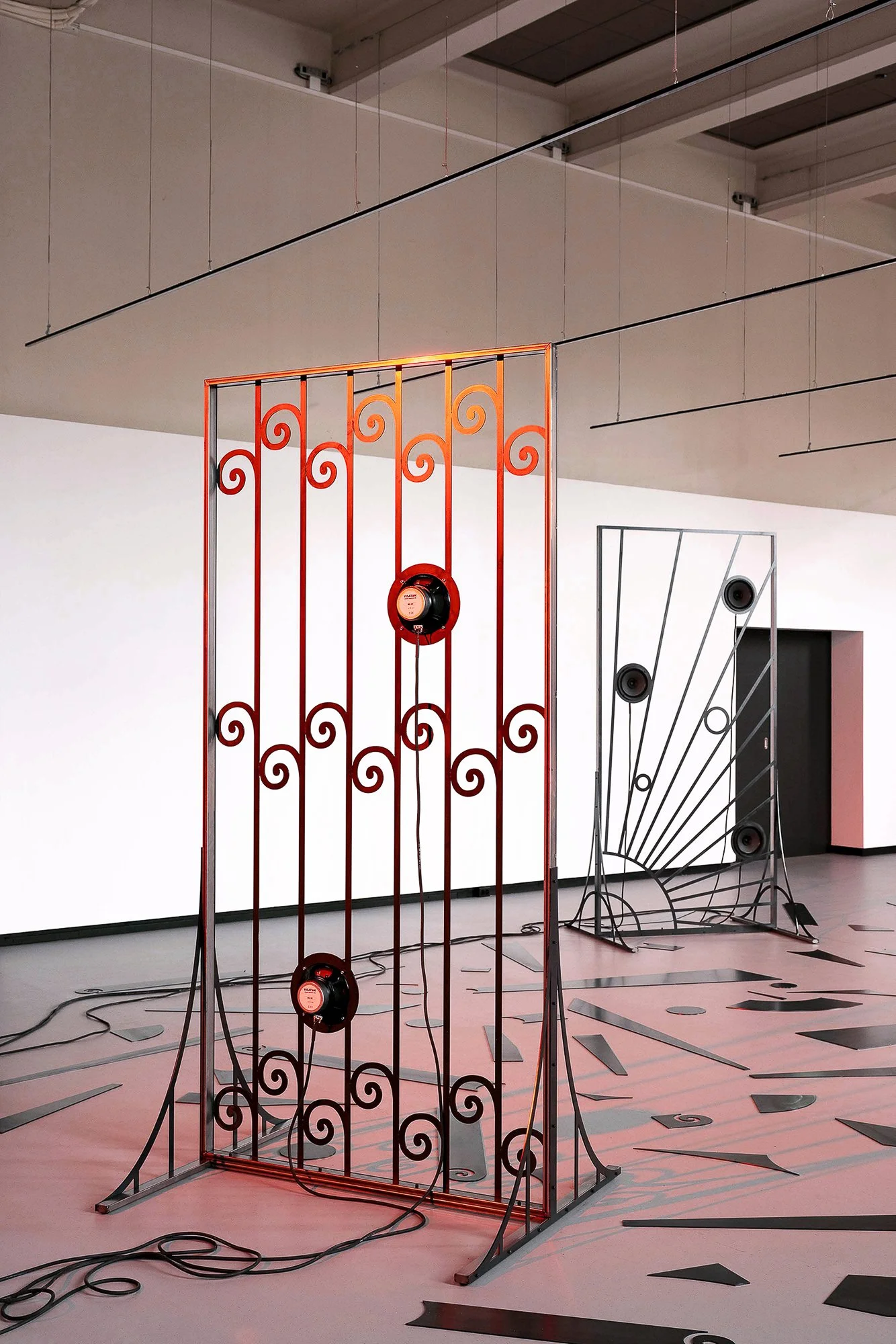
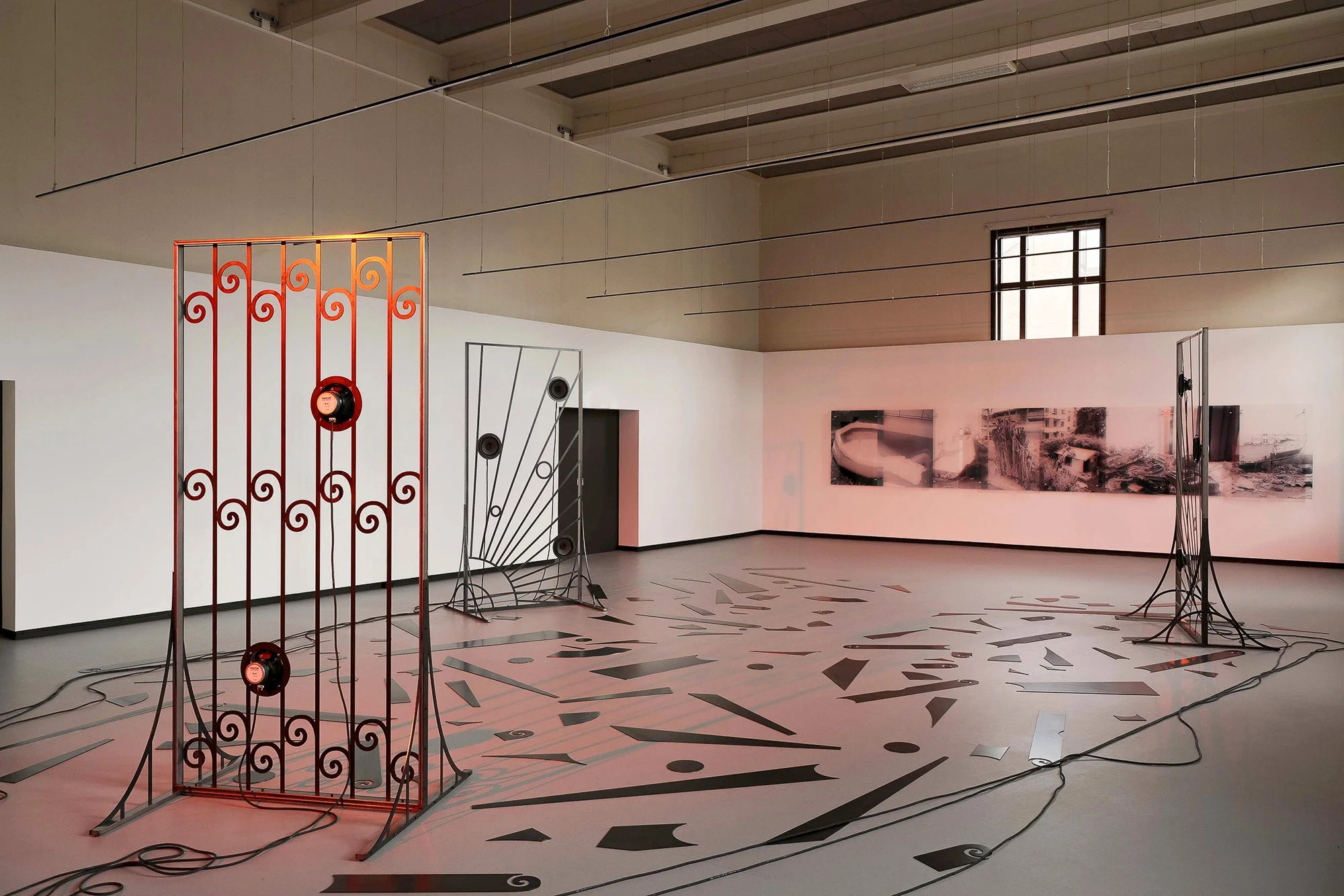
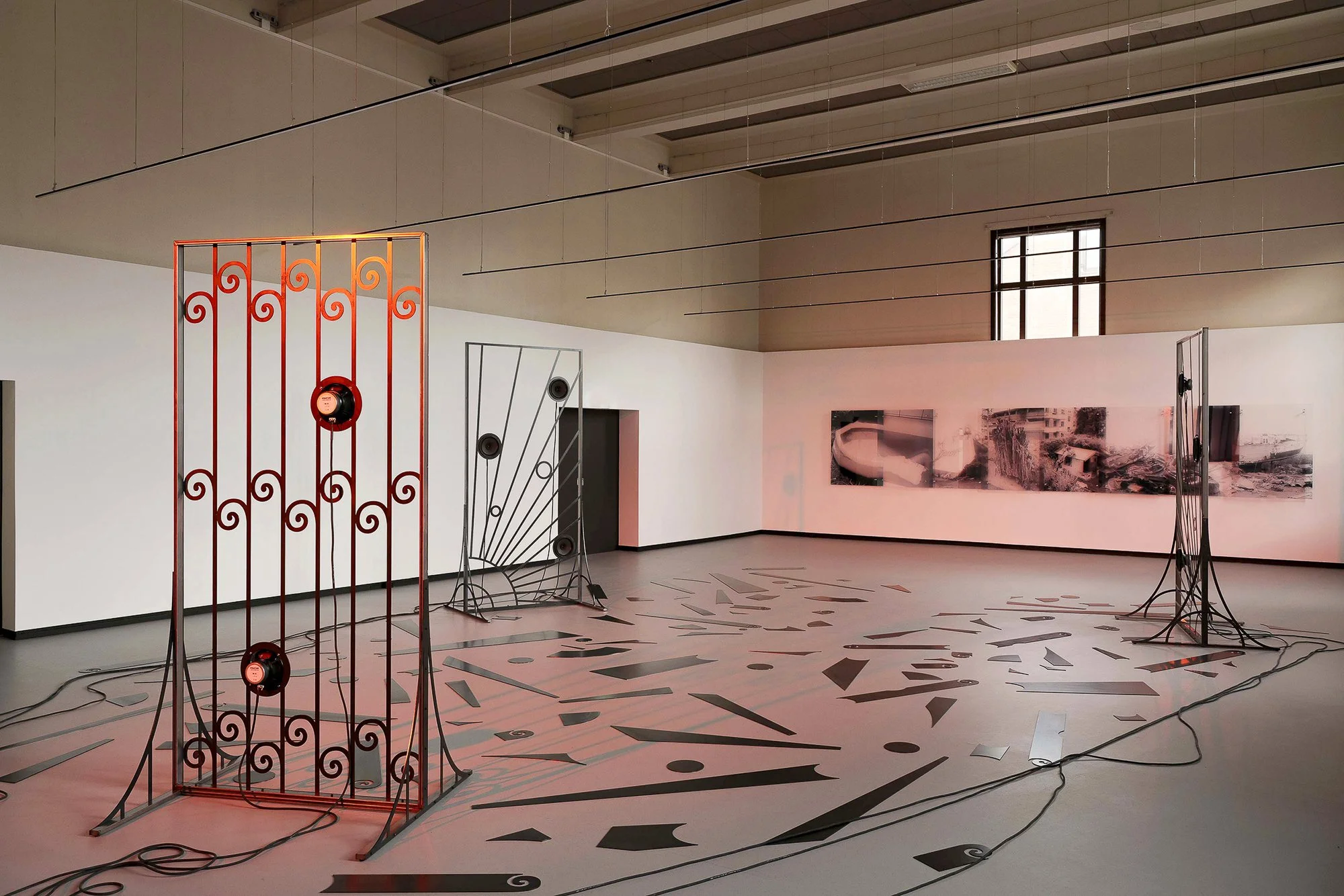
Before even entering the exhibition space, a dream-like, stringed ambience spills through the open doors. The soundscape, titled Wacky Fall and created in collaboration with composer Henrik Skram, emanates from three steel gates fitted with speakers. This ambient wash is fractured by the noises of clashing metal, objects striking the floor and rolling away, and crescendos that warp and bend in pitch, mimicking the rush of a passing object. Repeating throughout the 18-minute loop are fragments of «cartoon falls» — a drawn-out, plunging pitch that signifies a comedic descent.
Yet, my sensory immersion is almost immediately disrupted by the physical setup. Cables powering the audio snake across the floor toward the stage, framing the installation in a way that feels unintentional rather than deliberate. These exposed cords offer no clear conceptual weight; as I step over them to observe the installation in-the-round, I question the decision to leave them unsecured. Rather than utilizing the cables as a material to draw lines to activate the room, they wiggle haphazardly toward the center of the stage. They passively reinforce the spatial composition of the installation, and perhaps are meant to mimic disorder, but overall they contribute little to the work’s meaning.
Balke’s use of NŌUA’s unique architecture — specifically the lingering presence of its stage — creates the atmosphere of an aftermath. It feels as though I have arrived just after the shattering and dissolution of the metal structures. However, this destruction is clearly staged. Amid the triangular formation of the black steel gates lie fragmented steel sheets cut into various shapes, distributed across the floor with an artificial, even spacing. I read these as the off-cuts from the gates themselves; the negative spaces within the standing frames directly mirror the positive shapes littering the ground. Though these pieces form a maze to traverse, their pristine arrangement undermines the chaotic violence implied by the soundscape.
On the stage, a lighting fixture casts a burning red-orange glow through one of the gates, throwing long shadows onto the floor. The light is evocative of a sunset, or perhaps a sunrise. In Bodø and throughout the circumpolar north, where the coastal light stretches, bleeds and shifts across vast horizons, this artificial glow feels incredibly specific to the local landscape. Especially in these summer months, it recalls the low, heavy light of the northern sky “that glides unnoticed into sunrise” as is described in the exhibition text. In all aspects — audio, object, and illumination — the installation hangs on this pendulum of uncertainty, questioning whether the viewer is witnessing a rise or a fall.
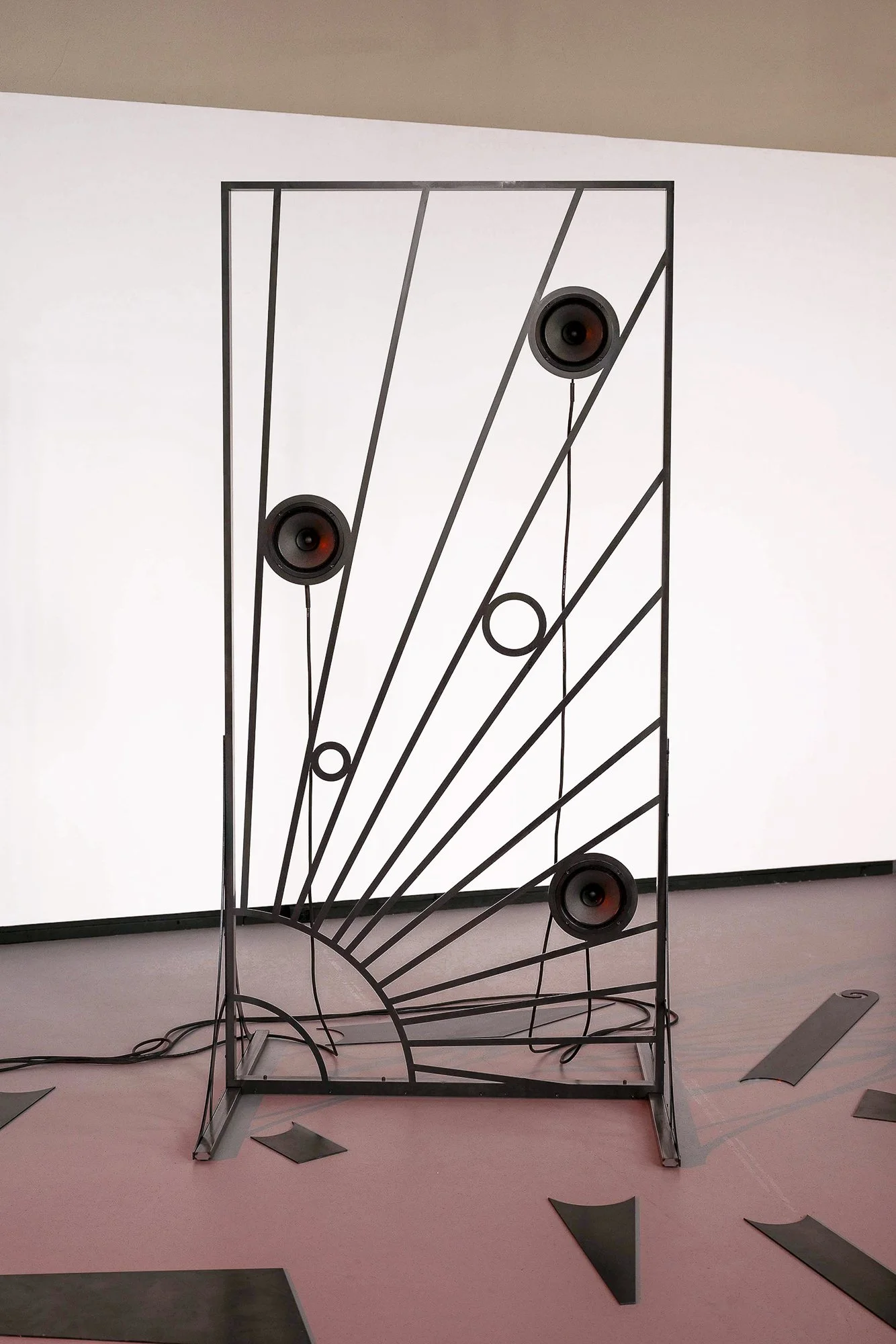
The gates themselves stand isolated, serving as housing for the audio equipment rather than doorways to an actual destination. They are decorative, akin to security gates or ornamental trellises: two frames feature a sunburst motif with radiating lines, while the third is formed by vertical lines and spirals mimicking waves. The strength of these sculptural elements lies in this dialectic of removal — the tension between the empty spaces inside the frames and the discarded metal on the floor. These designs are immediately legible, echoing the faux-sunset light that bathes them. Yet, while the structures are physically robust and well-crafted, the deeper significance of their illustrative imagery remains elusive. Perhaps these easily digested, almost cliché forms function in tandem with the soundscape’s slapstick sensibilities — establishing a strange friction between an inoffensive visual world and the terrifying trajectory of a sudden fall.
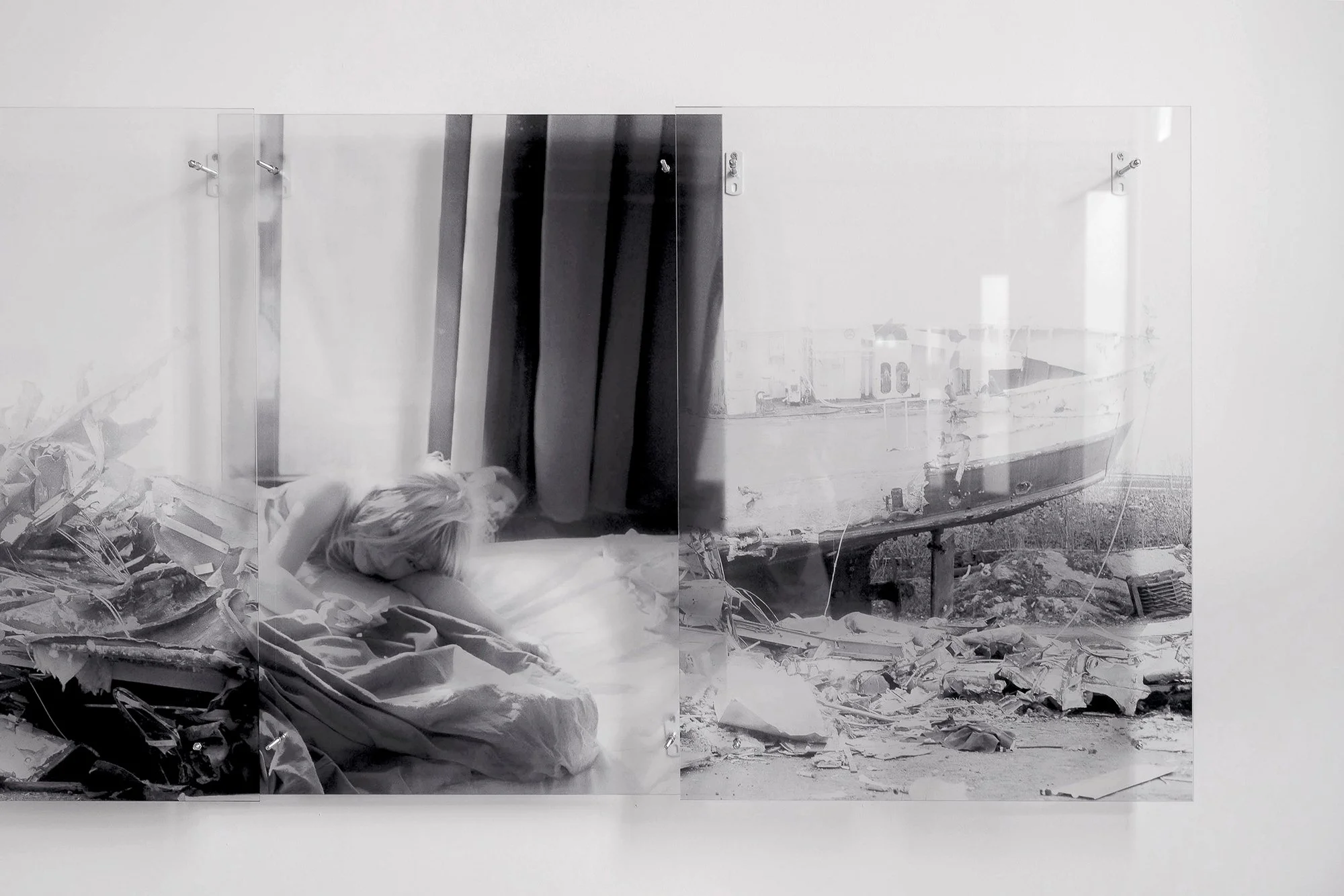
In the back of the gallery, an expansive photographic collage spans the wall. Panels of UV photographic prints on glass overlap slightly at the edges; when approached from the side, their intersections blur, merging disparate snapshots of ships, figures, and everyday scenes. Printed on glass, the subjects resist a straightforward reading. The glare from the gallery windows, the red-orange stage light, and my own reflection all interface with the surface, creating a new level of depth within the images. Both from afar and up close, the images are fraught with a productive, unresolved instability.
Ultimately, the work in Bunnløs succeeds most when it embraces the formlessness of its subject matter rather than actively trying to construct it. While the shifting soundscape effectively mimics the terrifying velocity of a plunge and the uncertainty of such a descent, the physical sculptures themselves refuse to give in to gravity. The heavy steel gates are simply too robust, too carefully engineered; their pristine stability betrays the chaotic collapse implied by the elements lying on the floor. It is instead in the quiet expanse of the photographic collage where Balke truly captures the instability and suddenness of vertigo. On the slick, overlapping glass panels, the world genuinely slips out of focus, delivering the precarious, bottomless sensation the exhibition's title points to.