
MAYARA BAPTISTA: VALID DOUBTS
Interview with Mayara Baptista, a part of Open Out Festival 2025

– Sometimes we are looking for an answer in a language that doesn’t exist. As part of this years’ Open Out Festival in Tromsø, the performance artist Mayara Baptista takes me on a journey into the opportunities and restrictions of our voices and languages, challenging ideas of what the mouth can do other than just talk.
Text by Carla Wedderkopp
Open Out Festival, this year arranged at – and in collaboration with – Tromsø Kunstforening, showcases artworks, workshops and performances produced by queer people from all over the globe. The festival has built up a community of locals and visiting artists, creating a treasured space for the queer art scene. One of the artists that participated this year is the Brazilian performance artist Mayara Baptista who presented their performance Vozes.
Manera
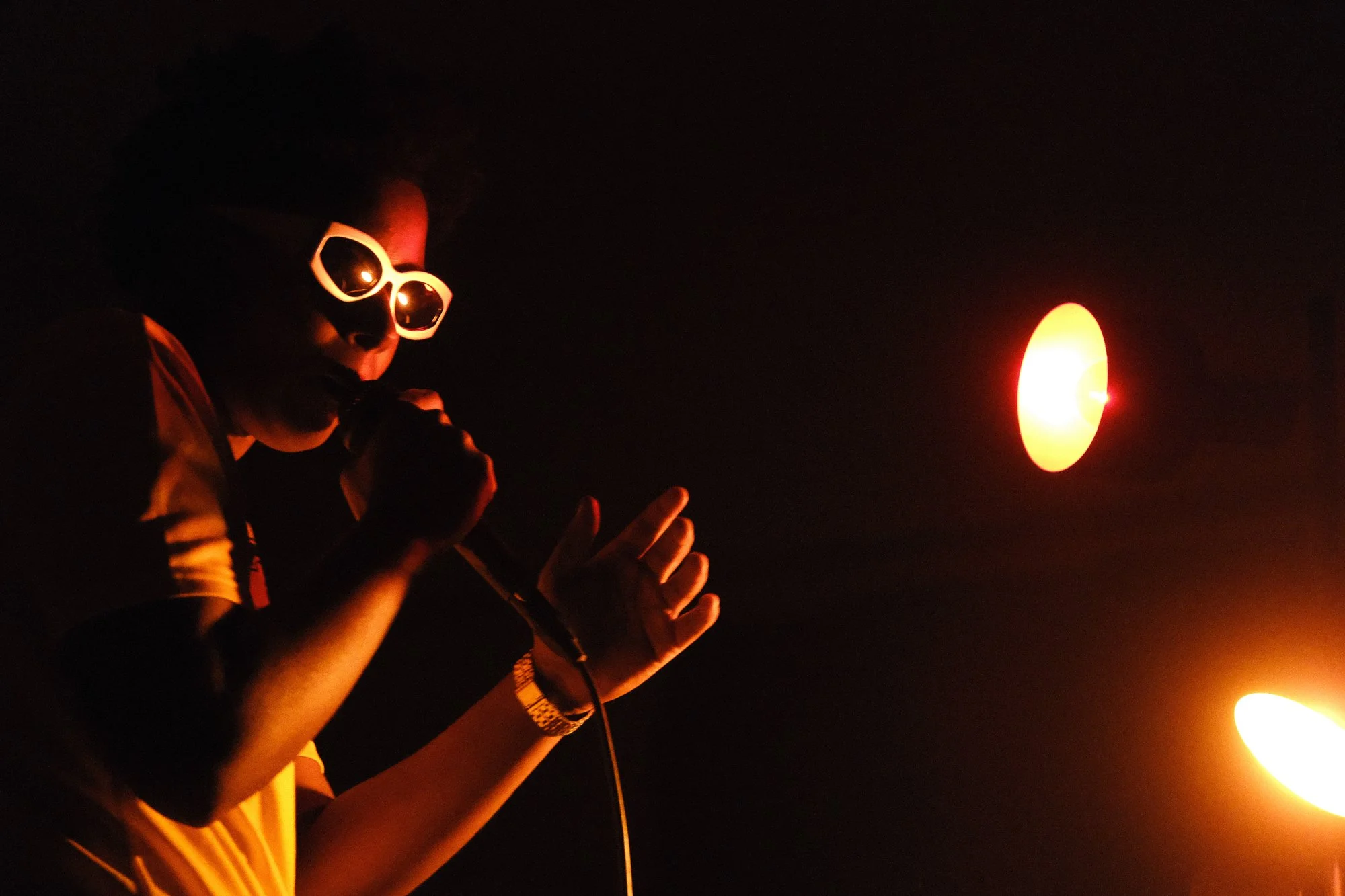
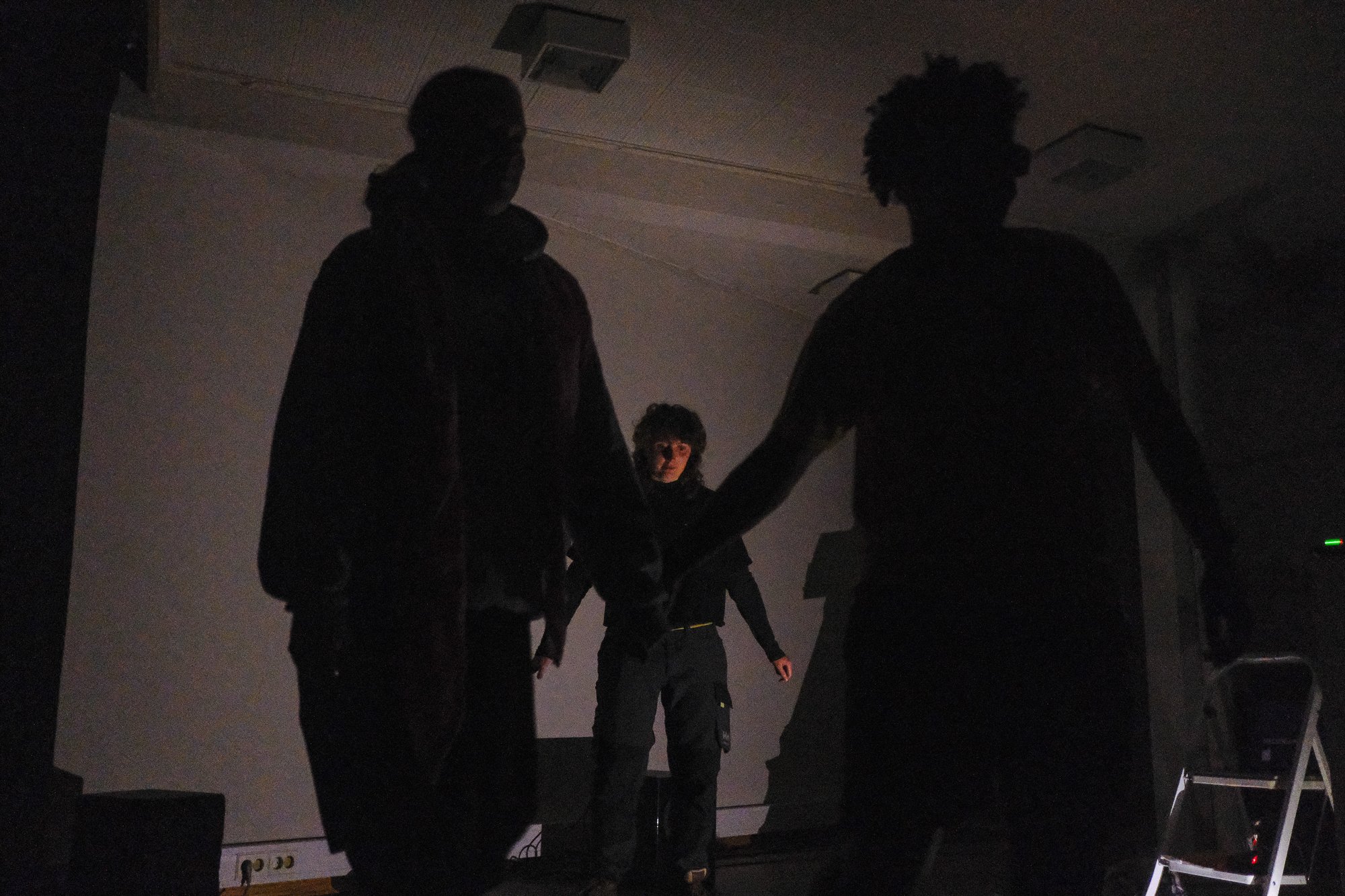
The performance began with the artist walking around, telling people to speak to each other in their mother tongue. Not long after, the crowd was led up the stairs into a strange and dark room. Baptista would go on to perform, using simple but effective stage lights, a loop station and, of course, the voice – both the artist’s own voice and the audiences. Sound and language were explored in seriousness, confusion and laughter.
I have only met the artist briefly once before, where we established that this interview would need to be executed with a bit of patience and some creative solutions, as Baptista is fairly new to English, and I don’t speak Portuguese. I have faith, though. Baptista has an app on their phone that allows for a running digital translation of our conversation. And after all, the work they presented at the festival was about the insufficiency of language.
Baptista is originally from São Paulo and has a degree in Web Design, Performing Arts and Voice Acting from Senac São Paulo. However, Baptista is not very fond of academics.
– I don’t like academics; I don’t like the oppressive space. I don’t like how things happen there.
Why is that?
– My school is life, the street. I’ve worked in many theatre companies in Brazil. I worked in Coletiva Ocupação, a collective of young people, talking about the occupations in the schools. There was a time in Brazil, in São Paulo specifically, where the government would close the schools. So, we set up a piece about the occupation in these schools. We traveled a lot in and outside of Brazil. I went to the UK. I went to Portugal. After that I worked in Teatro Oficina – the biggest theatre in Brazil.
When you travelled with the theatre play about the occupations, did you feel like the theme resonated with people outside of São Paulo?
– I think Brazil has another reality. It has another manera.
Manera is a Portuguese word used to describe another way of living, Baptista explains.
– For me, colonisation is the grand difference. It defines how you live your life. Because the people, for me…
Baptista is struggling to find the words in English and speaks into the app in Portuguese. But something seems to be glitching and is causing frustration.
– Sorry, Baptista apologises.
No, don’t say sorry. I think it’s kind of fun that we have this barrier. Because your work is about that, not being able to understand each other.
I laugh, but Baptista seems more frustrated than amused.
As the app starts to co-operate the artist looks me straight in the eyes while speaking into the phone with fluidity and ease. I get a sense of how natural a speaker Baptista is, and it hits me how it is actually not very funny at all when the app glitches. I’m missing out on such a crucial part of Baptista; the part that is their mother tongue.
– For me, performing in Europe is strange because people have an image of Brazil. They have an image of what the people and culture are like. They have an image of football. They have an image of a half-naked woman, of sexuality and freedom. I came out of a totally different place, and now I’m here in northern Norway. I’m learning English. For me, speaking English is a way of de-colonising within a system. And I’m entering the system to be able to work, to be able to live in another country and change my life.
Your performance yesterday very much depended on the room. We were all listening to you, but most of us couldn’t understand what you were saying. Sometimes you would speak loud, you would be *dgh-dgh-dgh-dgh-dgh*-almost angry in your voice. Or you would be demonstrative and dominant. And we could not understand you. But you would do it anyway!
– I think my work deals with this: why do we have to understand each other in a language? I think there are many ways for us to communicate. There is the look, the touch, the vibration. We can communicate in another way. I think that during the performance, people could understand this a little, but not exactly. Often people are not open to this. Sometimes we are looking for an answer in a language that doesn’t exist.
Galera
You’re here as a solo performer, making your audience perform with you, almost like a theatre company. Is that how you usually work?
– Yeah. The audience is your mirror. You spend the whole morning memorising a text so you can say it looking at someone. I like looking people in the eyes. People have eyes to look at. People have mouths to talk, to kiss, to do whatever they want. For me particularly, people here [Northern Europe] learn English but they don’t communicate.
Do you think that Brazilian culture has more tradition for this exchange with the audience? That there’s more tradition for being sensual, for using eye contact?
– I don’t know if you’ve been to Brazil, but that’s what carnival is. Packed with thousands of people looking at each other, touching each other, dancing and kissing. That’s what carnival is. People. It’s a time to share joy as a group. Obviously, there is a conservative side of Brazil. But I’m on the completely opposite side. I’m on the side of the street with the galera, Baptista says and explains how galera is a Portuguese word, meaning “the people” or “the crowd”.
Exposure
I feel like humour is the best international way of communicating. Yesterday at your performance, when people started laughing it was sort of the bridge to understanding the situation. What do you think about that?
Baptista thinks for a long while and then starts to speak Portuguese into the phone. At some point, Baptista looks at me and stresses a point in English:
– My body is political.
Baptista continues to explain in Portuguese and I try to pay attention to their eyes, mouth, the weight put on certain words. The tone changing. The sense of urgency to be heard.
– Humour can be one way of communicating. And it can be a lighter way to approach certain subjects. In my work I talk about the body I inhabit – a black, Brazilian, lesbian person with several social issues. It’s very easy for people to look at me and say: ‘oh, she must do something very political’. But my body is already political, so I don’t need to try. My way of existing is by making art and by putting people’s thoughts into doubt. Because that’s what I have realised: in Europe, when people look at my work, they have doubts. I think that this doubt is valid. I expose myself a lot. I bring up issues of sexual abuse that I suffered in my childhood. I bring up racism, police violence, domestic violence, and various issues that I face. Theatre is also a game for me, and I provoke. I have fun that way.
Baptista continues to explain that there are important things happening in their performance work that people are missing out on because of the language issue. Because of this, Baptista is learning English. However, having to learn English to communicate with the audience is certainly also problematic.
– There is also a question: why are people so trapped inside a box that they don’t even bother to make an effort to know what the other person is trying to convey? You went to my performance. You researched my travels, you researched where I’m going, but you didn’t research a word or a phrase in Portuguese for you to communicate with me. You simply came here: ‘of course she’ll understand my English’.
In my response to Baptista I can hear myself sounding agitated. I’m trying to control it. I want to be curious instead.
There are many ways to meet people. And I think assuming someone will understand you is a sign of being closed to the world, because everyone needs to make efforts in order to be understood. We need to put ourselves beyond our comfort level to be understood. But it’s interesting how English is this common language of the world even though many people don’t speak English.
– Yeah, this is about access! But do you understand my point?
Yeah, I understand. I think you had many points.
But I know what point Baptista is referring to. It’s about privilege. I am used to other people adapting to me. Now, still, in this interview, I am assuming that someone else will adapt to my needs, my preferences. If they can’t, it won't cost me much, but it will cost them their voice.