Smart watches and tracked bodies
Review of To Be a Body, Is to Be Tied to a Certain World by Chollada Phinitduang, part of Insomnia Festival 2026, Rådstua teaterhus, 16th October 2026, Tromsø
Chollada Phinitduang’s performance utilises dance, installation and wearable tracking devices to create a visceral experience which raises questions about the role technologies have on augmenting the movement of our bodies.
Text by Ruth A. Aitken
In late 2017, the fitness tracking app Strava made public a vast amount of highly granular data, mapping the runs, cycles and swims of all of its users around the world. This action had the unintended consequence of revealing the location and layout of secret US military bases. In the last year, it has been revealed that military service personnel and contractors continue to give away the locations of bases and naval vessels in the Middle East, through the logging and uploading of their personal training data, potentially allowing for the targeting of US and UK military sites in the US-Iran war.
While the Strava instance is an irregular example of wearable-tech surveillance undermining traditional power hierarchies, there are plenty of other examples of consumer technology and smart gadgets impeding into our lives with a very clear power imbalance. These items are used by employers and insurance companies to control choices and/or deny claims in various countries around the world. More insidious, though less tangible, is the data which is constantly streaming away from us, knowingly or not; our smartphones now not merely communication devices, but extensions of our bodies and brains that have become necessary augmentations in contemporary society. This data is then used to shape our further movements, economically, politically and socially, through highly targeted algorithms in the search engines, social media and other networked spaces that we engage in—this having notably been used for the radicalisation of vulnerable individuals into various ideologies including ISIS, or in the instance of Facebook’s use of personal data during the Brexit campaign and the 2016 US presidential election. An even more horrifying advance in the ways technology, the body and power structures interact can be pointed to in the numerous examples of chatbots encouraging users to commit suicide.
These are some of the stories that I can’t help thinking about in the days after experiencing Chollada Phinitduang’s performance, To Be a Body, Is to Be Tied to a Certain World.
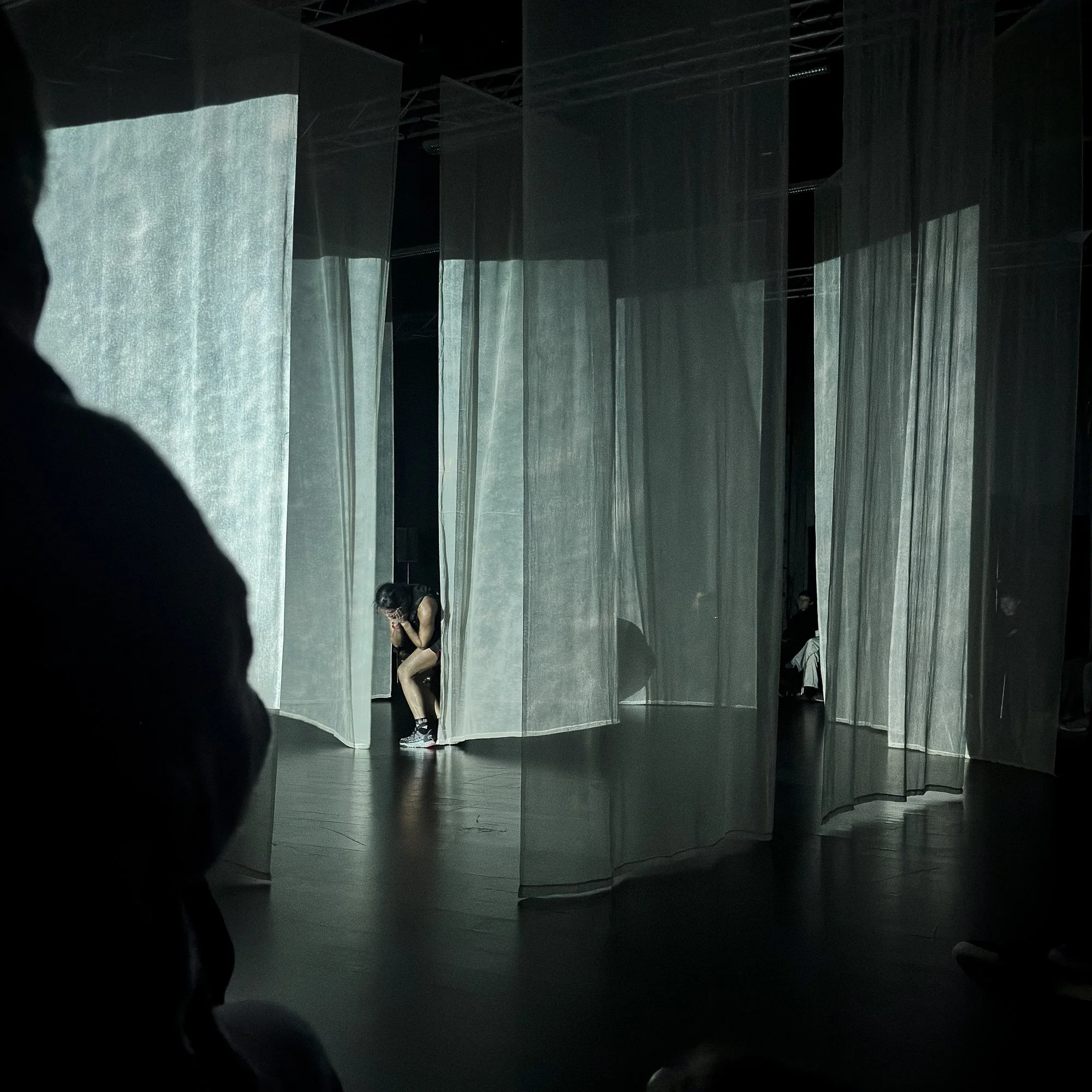
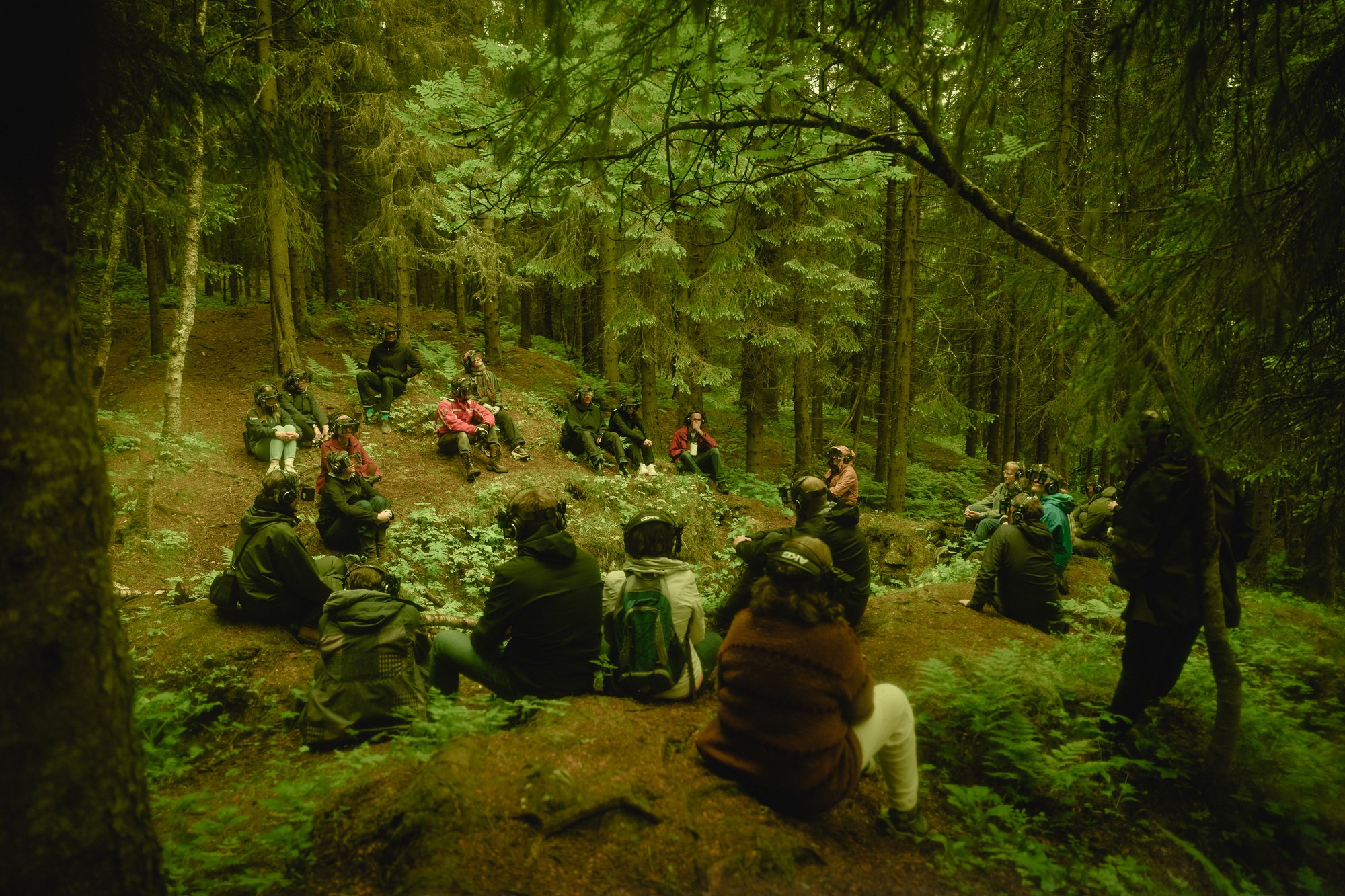
In a black-box theatre in Rådstua, a body moves slowly alone in the dark. Red anorak, black trousers. Semi-transparent white banners hang in pairs from ceiling to floor, each about 1.5m wide. They evoke a forest, a labyrinth, and an information matrix at different points through the 50 minute performance. They sway and breathe with every movement in the hall. As Phinitduang moves around the space, she whispers repeatedly, “In haste we stray, through life’s swift course, we speed away”.
Her performance returned to the North after starting its life here in Tromsø through an Art Lab hosted by Davvi Senter for scenekunst in 2024, before premiering at Dansens Hus in Oslo earlier this year. After it returned to Tromsø as part of electronic music festival Insomnia’s programme, I found myself ushered in to find a seat in a single line around the outermost edge of Rådstua’s Provisoriet, avoiding the white banners which occupied the entire space.
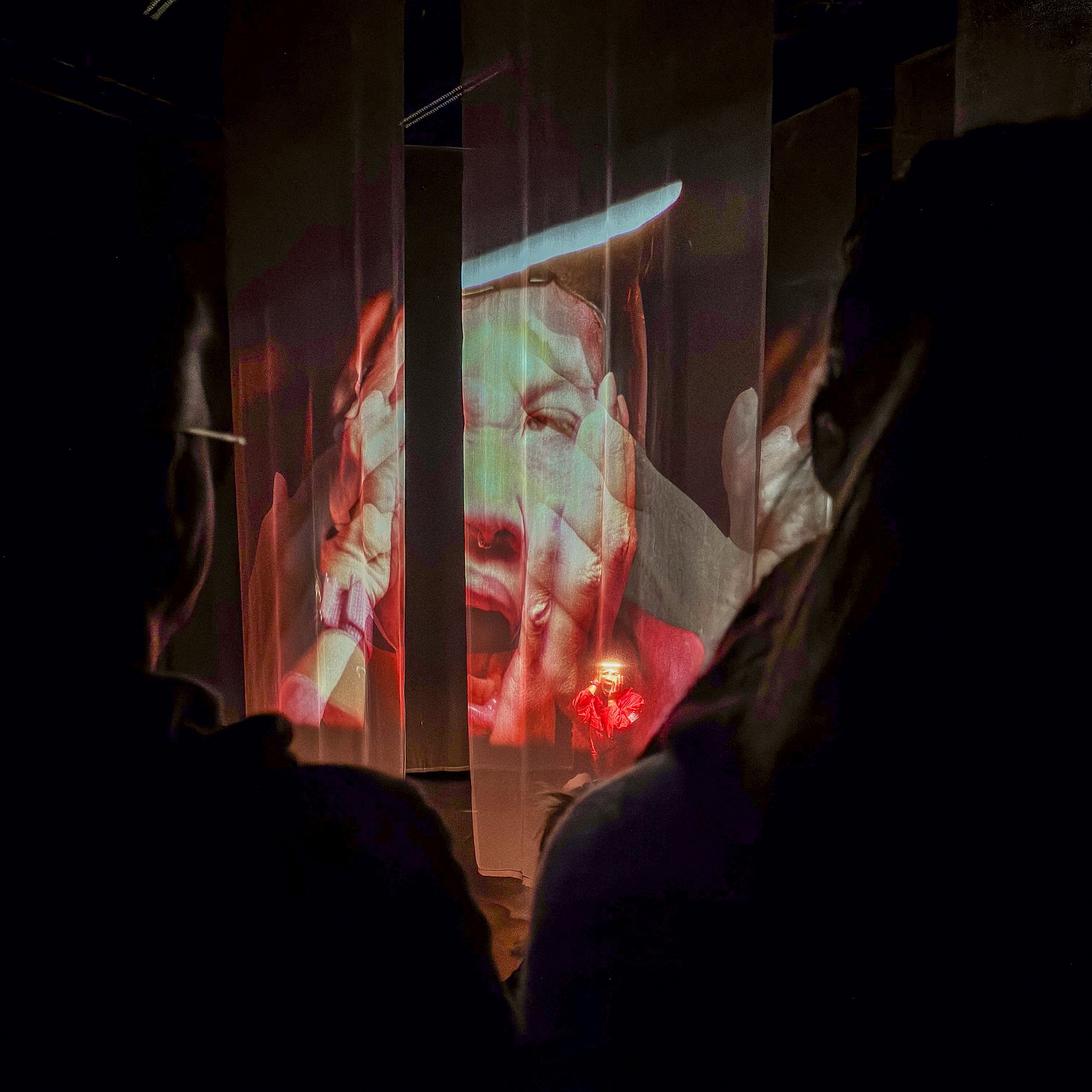
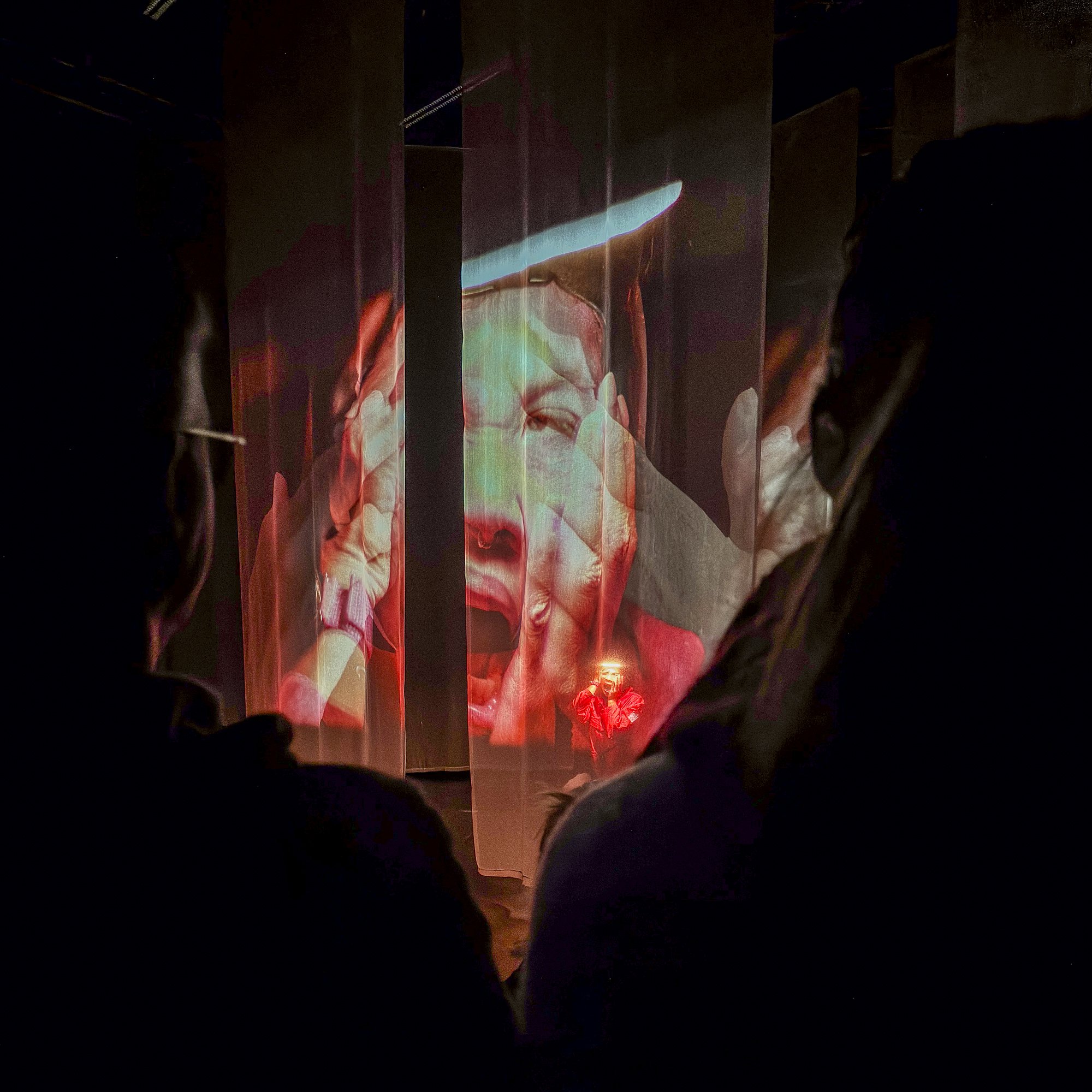
From my seat I see Phinitduang wander in the darkness gazing into a phone shaped light. Early on she dons what appear to be fitness tracking watches to her ankle and wrist, causing the sound to respond to her movements. She uses a live camera to project and respond to a close up of her own face, moving and manipulating her features in an uncanny way that brings into question its liveness and whether it is of this world in the theatre or an altered digital space.
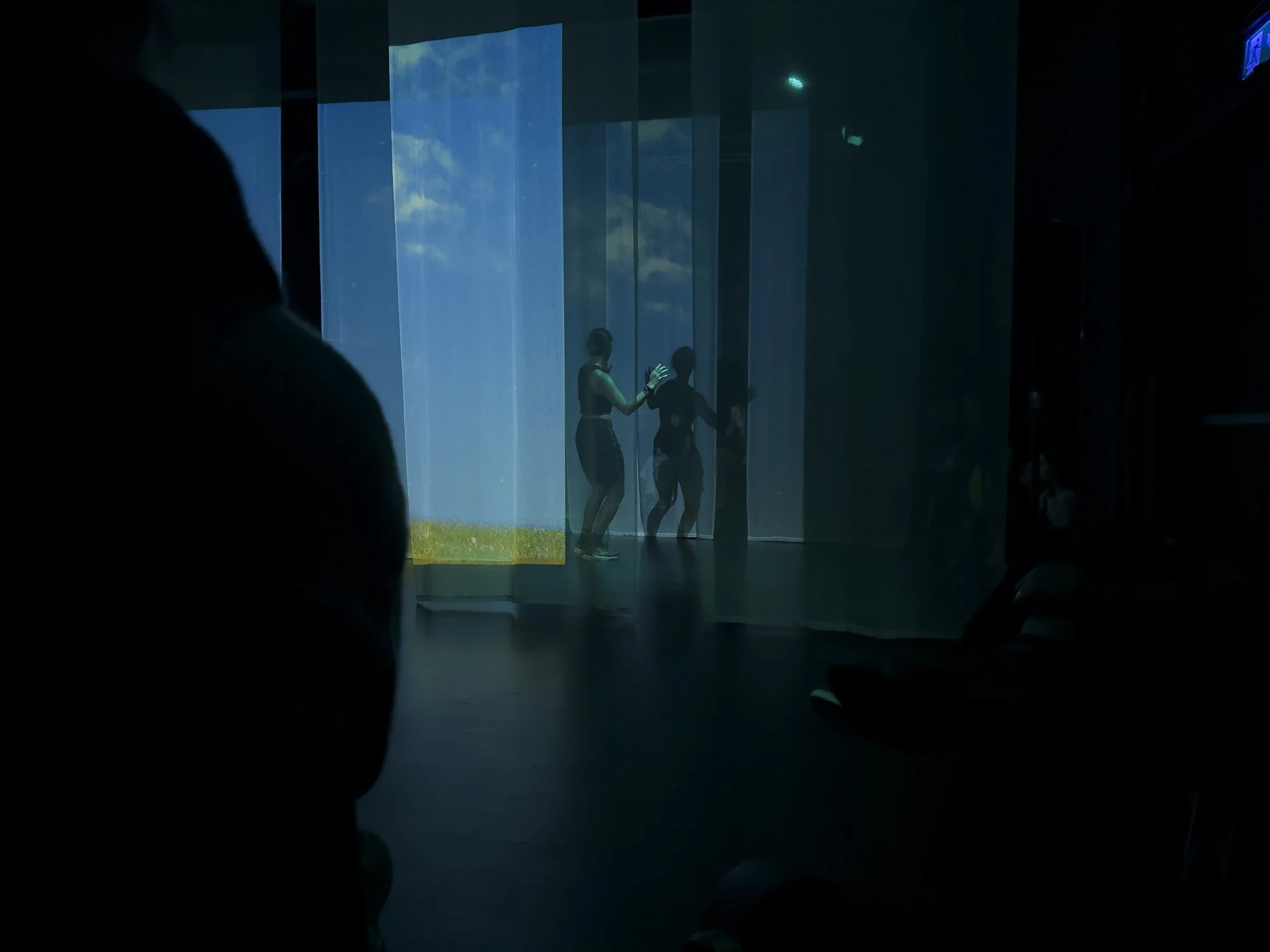
As the piece becomes more intense, more dramatic, faster, the banners frequently move, reconstructing the space, and we see pre-recorded video of Phinitduang dancing outside in a meadow, and imagery of a vortex projected through them. At one point, the white fabric banners spin rapidly while lights strobe, creating a moment of quite spectacular dramatic climax. Towards the end of the performance, as everything begins to still, Phinitduang returns to a vocal rumination on time, ‘“We want to be faster”, “I love speed as much as anyone else” and “here ...now”.
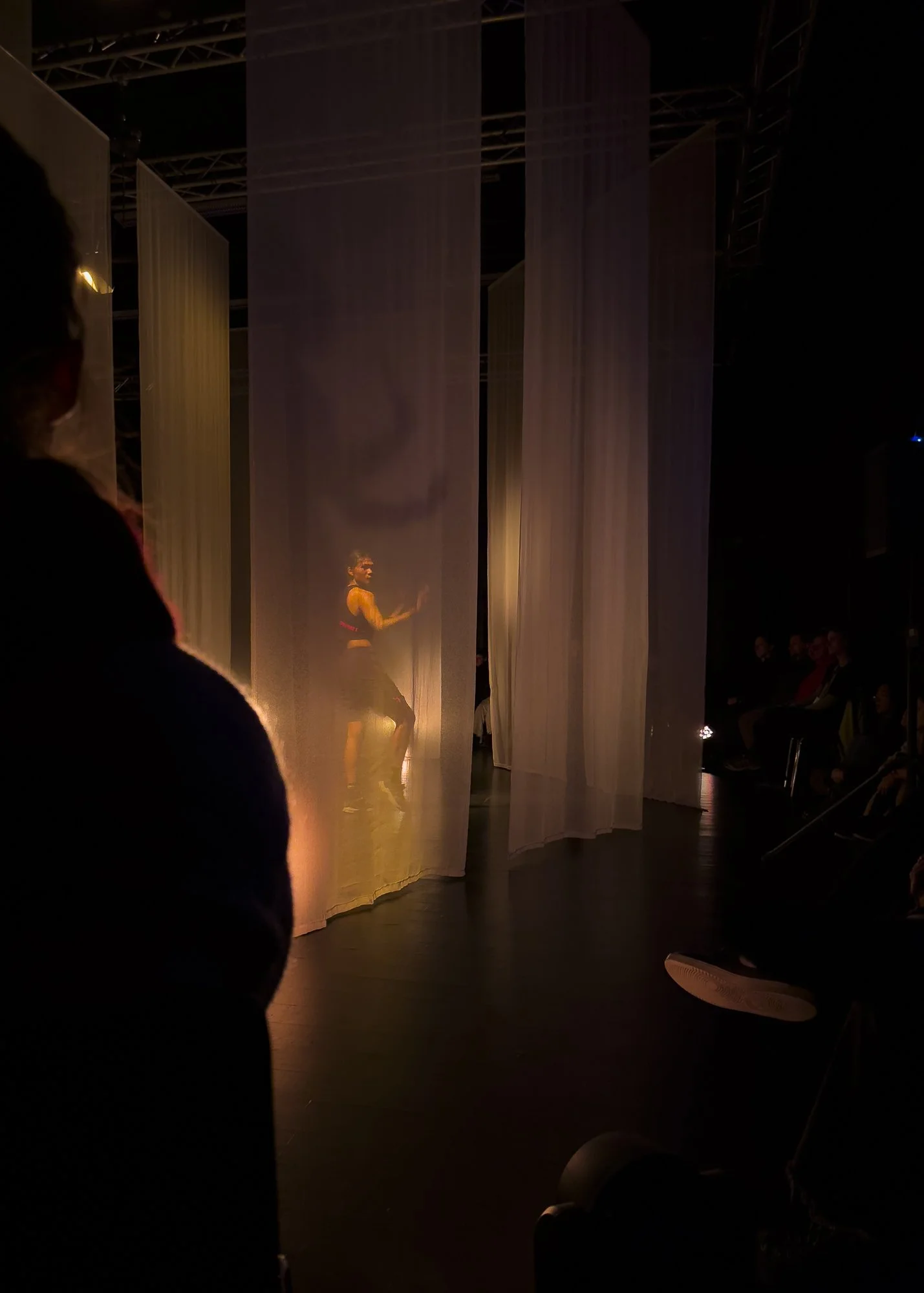
While Phinitduang is the sole body in the entire performance, she is by no means a solo actor; To Be a Body, Is to Be Tied to a Certain World is very much an ensemble piece. The scenography of banners was designed by installation artist (and Tromsø’s own) Lawrence Malstaf and choreographed in collaboration with Amanda Bach, moving often in response to Phinitduang’s touch. A soundscape and music from sound artist Lars Andreas Nilssen used the sensors in the smartwatches Phinitduang puts on which are then triggered by her movements. The projections, echoed and warped through the many layers of banners, were developed by artist Aleksander Johan Andreassen.
This ensemble results in a fragmented, changeable experience for the audience—no single audience member will see or hear the performance fully. Parts are obscured, distorted, and partially understood in an often simultaneously transcendent and frustrating way. This mimics the sensorial experience we can have with these technologies, which can promise us momentary access to a sense of endlessness, betterment and optimisation of the self, body and brain, while ultimately occluding it, never fulfilling it, and even perhaps reducing us in the process, as seen through phenomena like ‘digital dementia’.
The piece is at its strongest when it keeps things most focused, holding the audience transfixed in the space, sensing and subconsciously mirroring Phinitduang. The earlier acts particularly set a powerful grounding for the ideas that she raises. The slow interactions with a scenography that flits between feeling organic and mechanical, and movement that does the same, the curious and absorbed interactions with the sensors, and the direct responsiveness of all of these elements, serves to create an uncanny and visceral experience. Where the piece falls down is when it tries to lead the audience too much. For example, while the addition of a vocal component added an extra bodily aesthetic that was welcome, the poetics about time felt unnecessary and distracting, as the piece already invited us to think about these things while leaving it much more open to the audience to reflect upon. With the exception of the live screening of her face—a direct feedback loop of interaction and manipulation, that reflected on the constant recording, broadcasting and augmentation of the self—the representational visual projections disrupted the cohesion and responsiveness of the world that Phinitduang had built. They instead drew the audience to an external ‘real’ space that conflicted with the one we found ourselves in, and fell flat in such a visceral and considered setting.
As a holistic experience, it taps into a long legacy of discussion about the way we extend ourselves and/or become part of the technology we use, from Mary Shelley’s Frankenstein, Fritz Lang’s Metropolis, Marshall McLuhan, Ray Kurzweil [1], and to more contemporary analysis from people like Shoshana Zuboff and James Bridle. While discussions of this area can often trend to the extremes of opinion, either a deep technophobic terror or a technoutopianism at any cost, by grounding it so much in the body and the senses, To Be a Body, Is to Be Tied to a Certain World, has a more subtle yet urgent plea; to reclaim and free the body, to move of its own accord and at its own pace.
Note:
1: In 1999, Ray Kurzweil proposed an updated thinking of Moores Law, suggesting an exponential acceleration in technological advancements, to the point of singularity: https://www.writingsbyraykurzweil.com/the-law-of-accelerating-returns