
The Conscious Forest
Review of the performance Solaris? by Mathilde Caeyers (concept and direction; a complete list of contributors to be found here), 1.–3. July, Tromsø
An adaptation of a classic work of sci-fi leads to a weird and wonderful walk in the woods.
By James S. Lee
Solaris, originally a novel by Stanislav Lem, released in 1961, is probably best known now as the great Soviet director Tarkovsky’s (second) best film [1]. It also became a Hollywood production in the early 00’s, directed by Steven Soderbergh and starring George Clooney.
For the benefit of the reader here, it is worth summarising the basic plot found in the source material: a scientist is sent to a distant space station orbiting a planet called Solaris, a planet which, in turn, turns out to be harbouring a consciousness, a consciousness that can interact with and affect the minds of the crew on the space station, seemingly producing real people in their company.
Going into this performance by choreographer Mathilde Caeyers, I was intrigued by the tone this interpretation of Solaris would take. The films of Soderbergh and Tarkovsky are “heavy” (and other Solaris influenced artistic productions from Another Earth to Contact are real emotional gut punches), but the text introducing Caeyers’ performance, surprisingly, was light and playful.
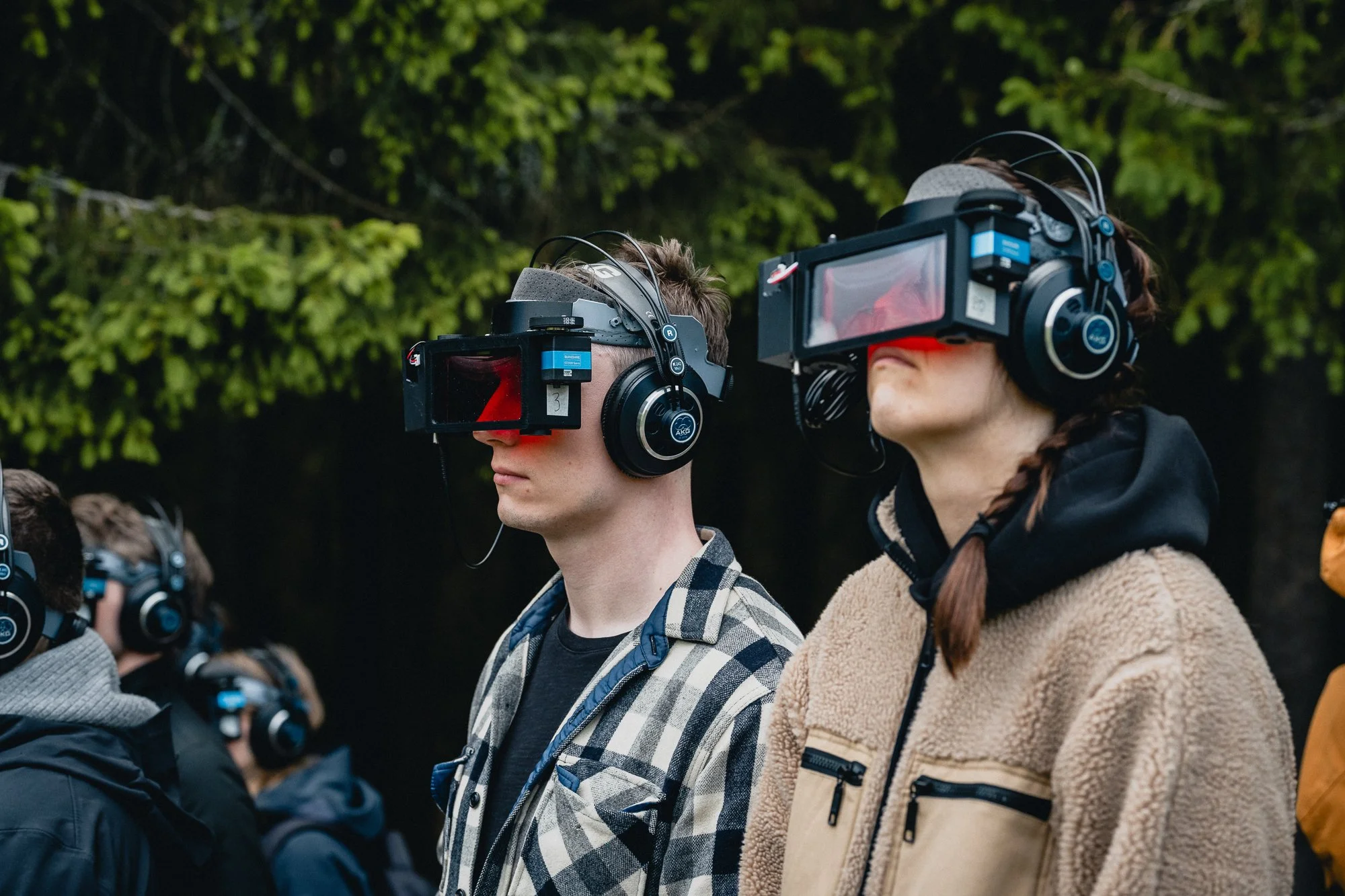
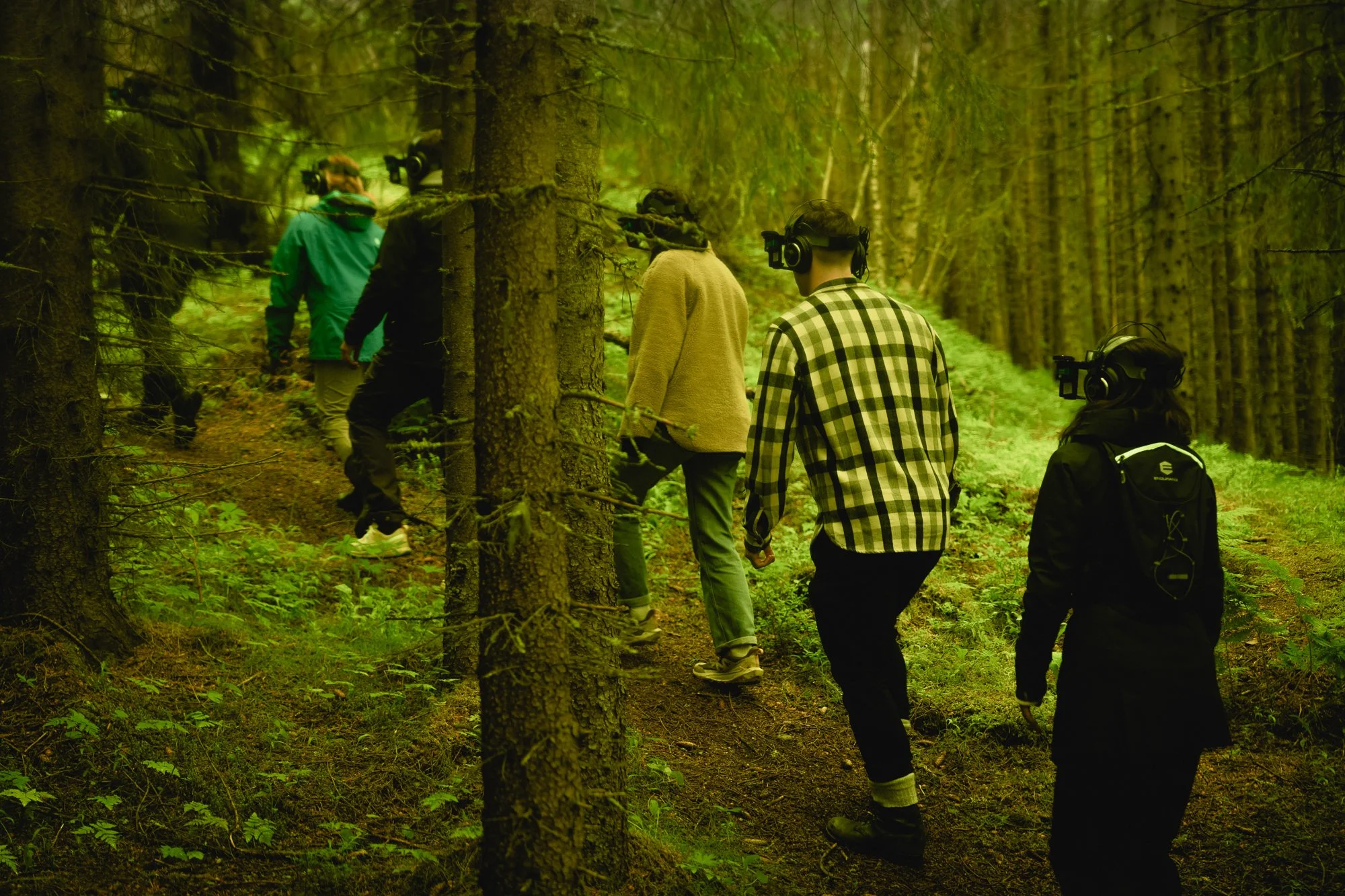
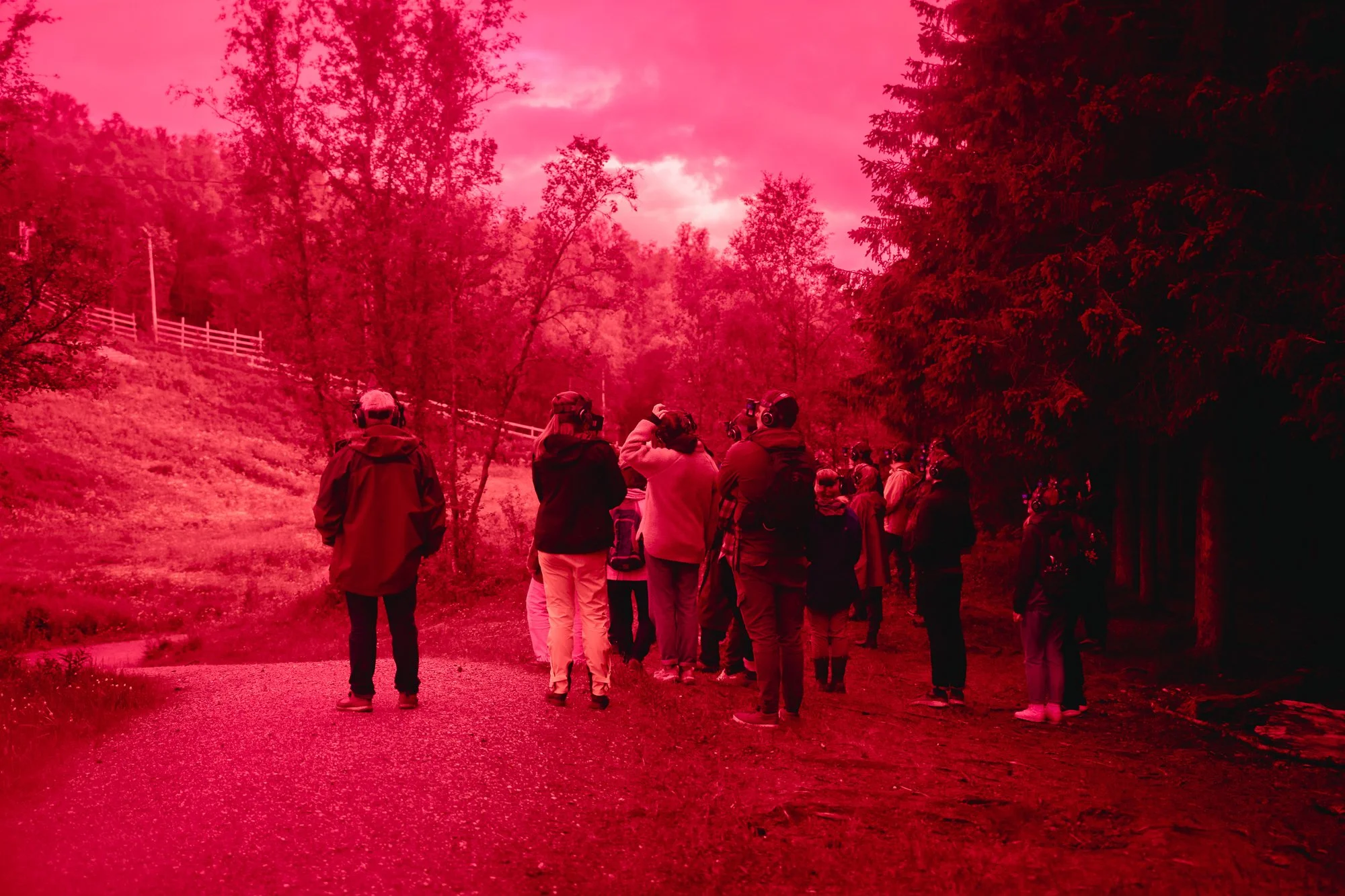
After having met up at the top of Nordheimvegen on the south side of Tromsøya on a grey summer evening—and with only the facebook blurb to affect my judgement—I was fitted with a headset by performance technician and contributor of “interventions” (as he called them) to this performance, artist Lawrence Malstaf. Then, off we went into the forest.
Following behind Caeyers, glitchy electronic rhythms started to snap in the headphones; a coloured filter moved across our eyes courtesy of the headset on our heads made by HC Gilje for this performance. Soon the sky above us would change from yellow to orange (and, by the end of performance, purple) as we went deeper into the trees.

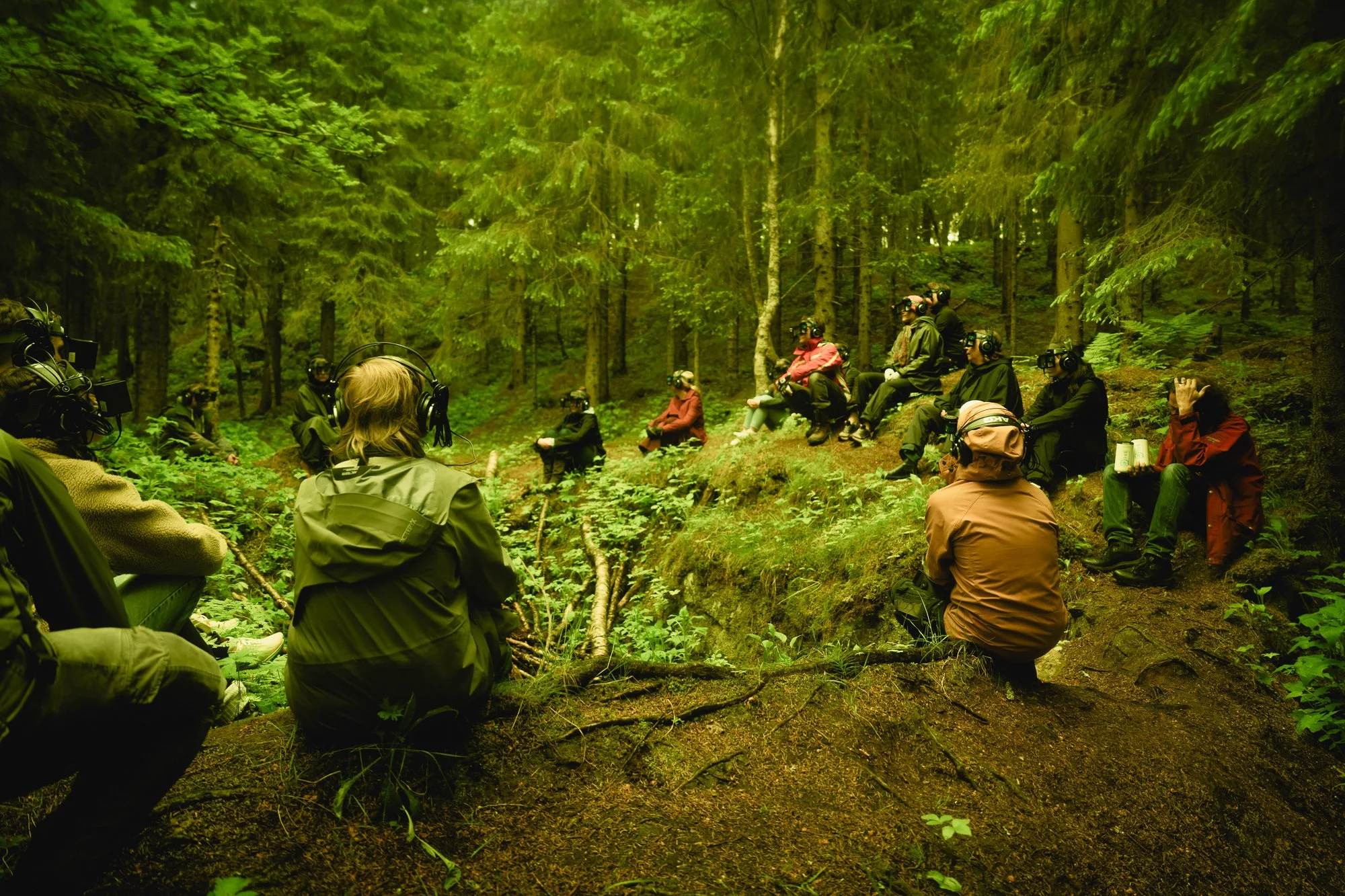
We walked by some glowing rings hugging trees, pulsing slowly on and off. With the yellow filters over our eyes, they glowed a burning orange. We walked past rocks that had been cast with holes drilled in them laid on the ground. We were invited to pick one up and take it with us onto the journey’s end. I put one in my pocket.
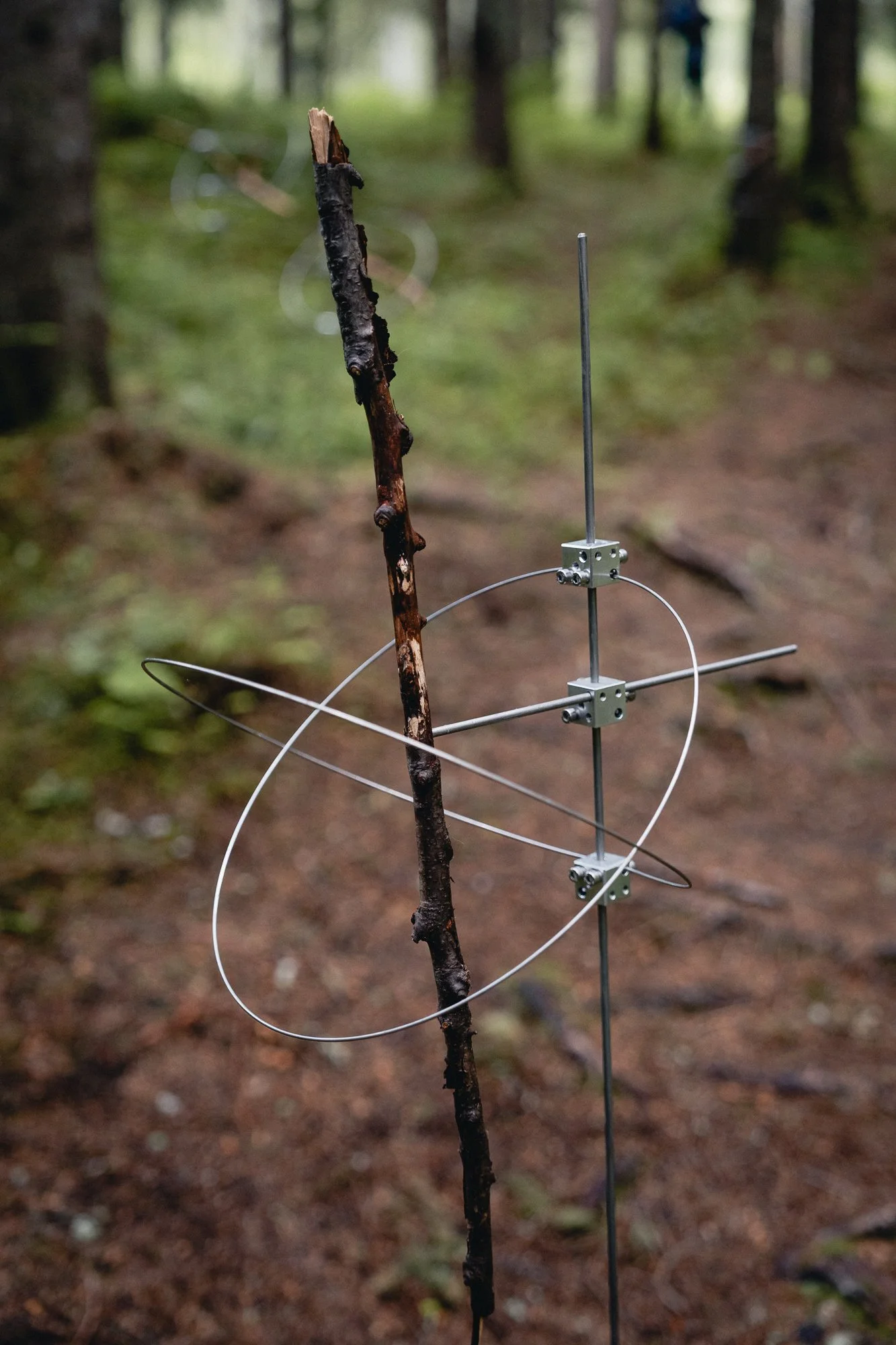
We passed sculptures that reminded me of works by Jean Tingulay, but were “interventions” by Lawrence Malstaf. Metal rods supported oval or circular metal shapes; jarring presences in their contrasts with the surroundings, both in form and in their metallic sheen.
As we came to the bottom of the Bak Olsen ski lift, we saw three people in tracksuits running down the hill. It is not uncommon to see people out running in this area, but immediately I could sense there was something off with these runners: their movements and constant stopping and looking around hinted that these men and women in tracksuits were no locals out for a late-night jog.
In our ears the whole time has been a story being read out in between bursts of very minimal and atmospheric electronic music. It was a script written by Mathilde Caeyers and Maria Dorothea Schrattenholz, with excerpts from the novel Solaris by Stanisław Lem. It began by stating we were on a training exercise to join the crew onboard the space station by the planet Solaris. It occasionally instructed us to stop and think of, for example, words, or do other simple exercises in our heads. There was so much going on during this walk in the forest—so much to take in visually, not to mention simply not tripping up in the slightly damp forest—the words, spoken in a rhythm that makes spoken word often forgettable, frequently became background noise. But still, it was a pleasant, soothing even, background noise for our evening adventure.

At some point, the narrator told us we had reached the planet Solaris. The performers— joggers in tracksuits—approached us at the bottom of the hill, breathing heavily, and then proceeded to pick up metal rods laying on the ground and planted them around us. The performers went off in different directions, moving fast into the woods, with various members of the audience following after each performer.
The performer I chose to go with (Karianne Andreassen) would soon begin to mutter nonsense. She would say words that sounded like another word back to back for an age (for example alternating between “roof” and “root”), so her speech became incoherent and unintelligible.
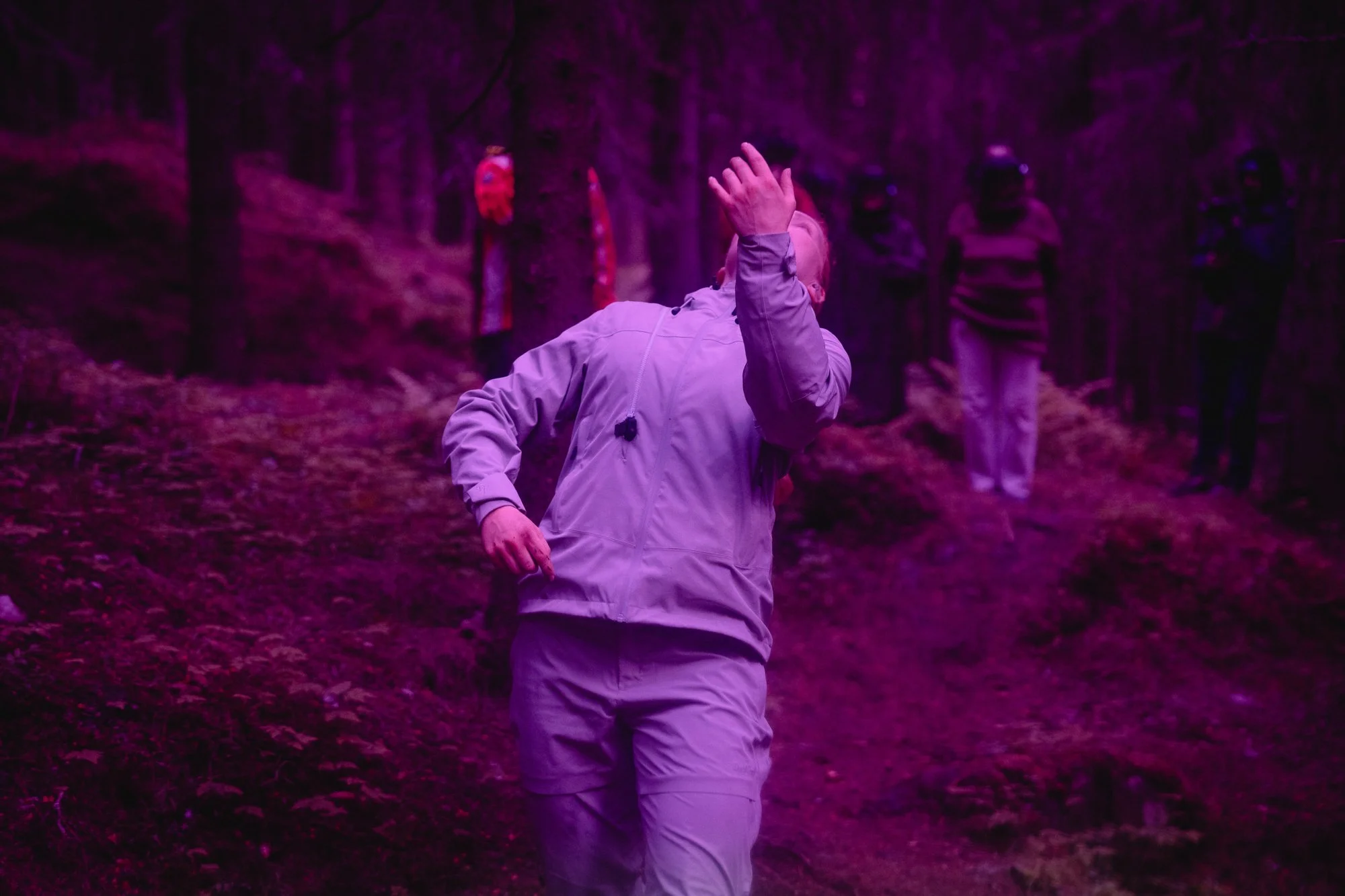
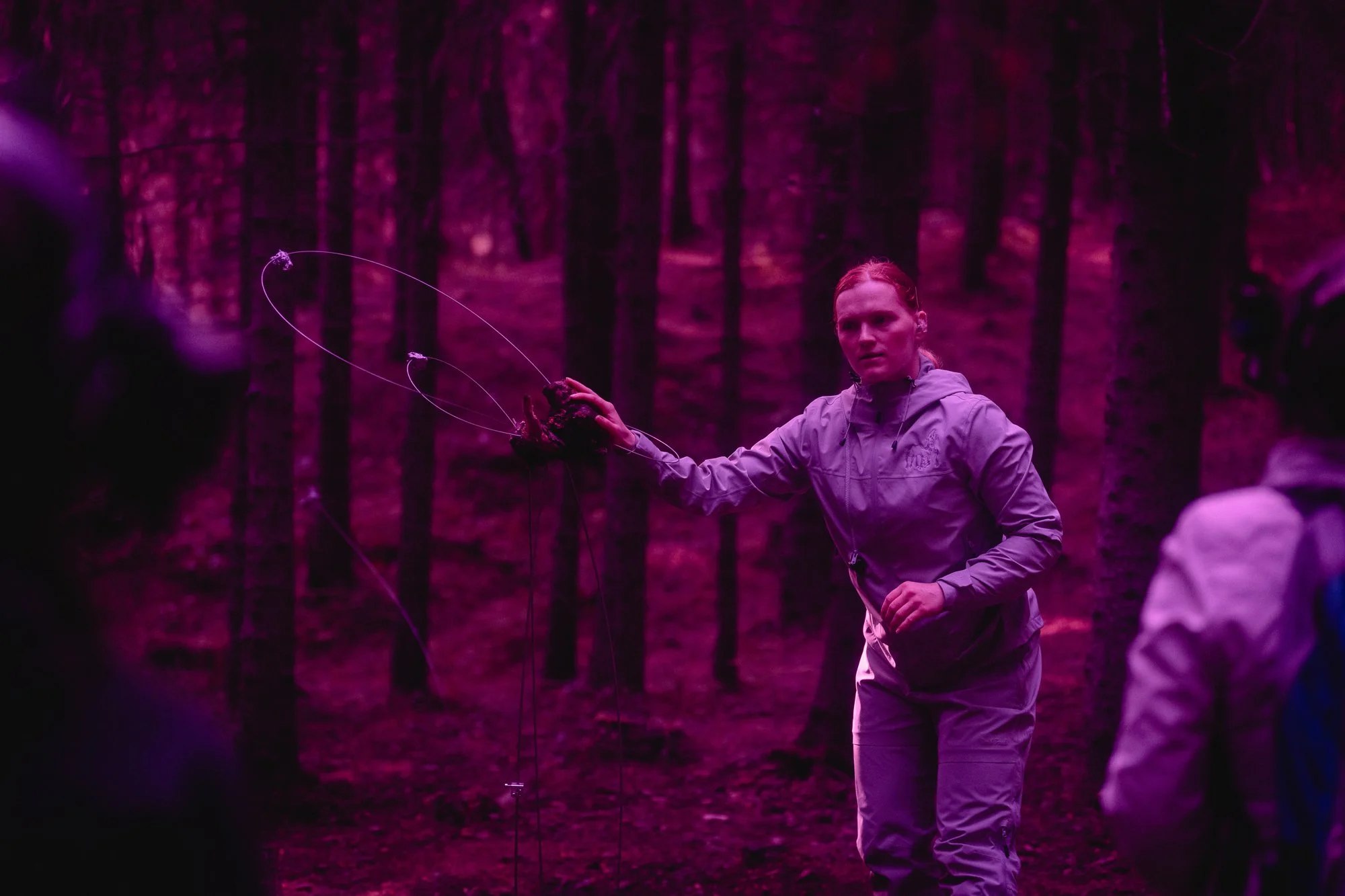
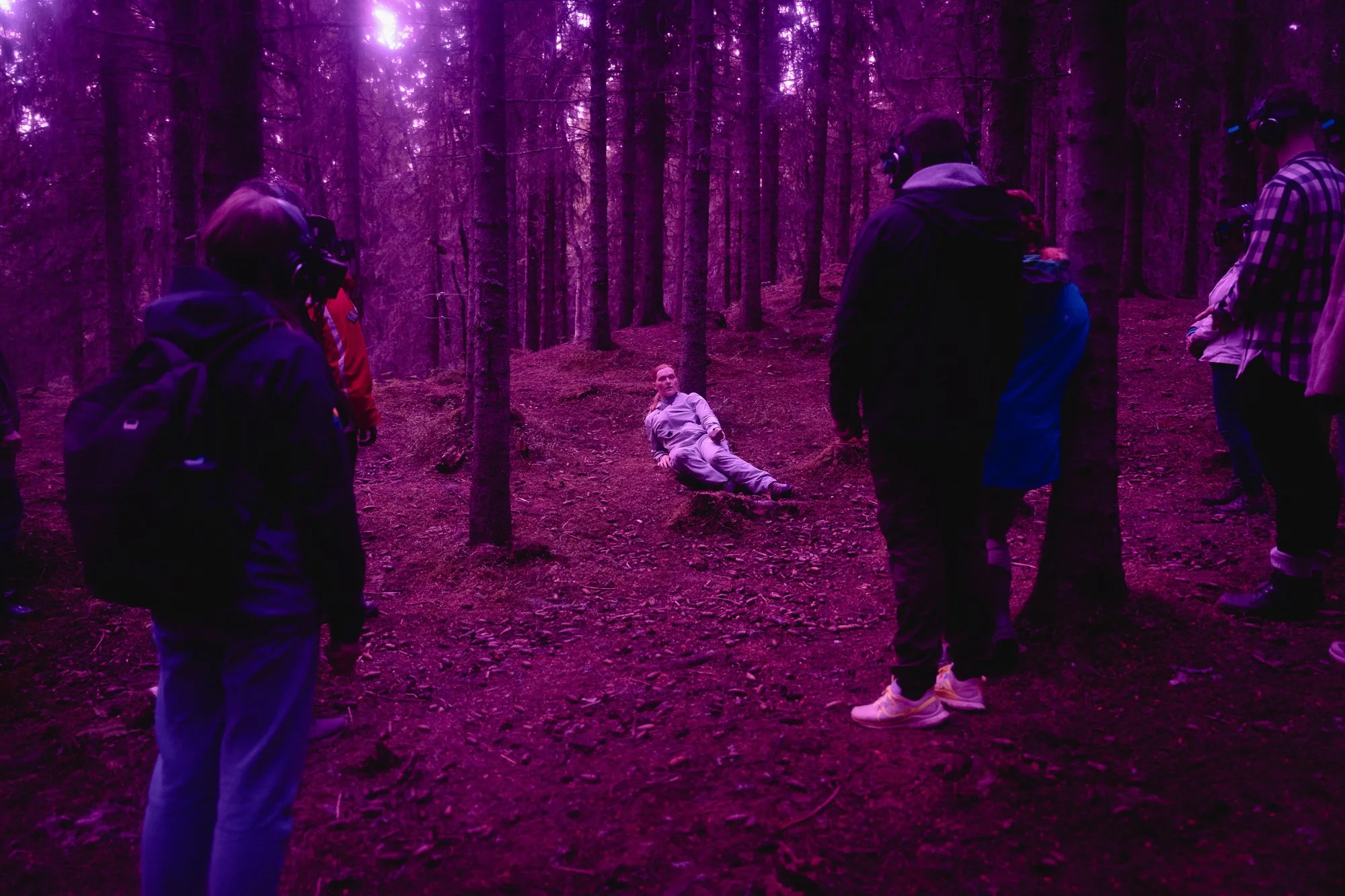

The performer started smashing her body in the earth, pounding her right hip in the dirt at one point, until her body ran out of resources to undertake the action any longer.
And suddenly, up she got and met up with the other two performers (Marit Meløe, Stian Bergdølmo). Jerking and jolting, and all acting like malfunctioning kitchen appliances, the performers moved towards an elaborate metal-based sculpture (by Malstaf) hanging from a tree that—due to the thinness of its hanging support—appeared to be floating. The performers approached us with an outstretched arm one by one and looked at us directly in the eyes, like confused drunks. Then - Ah! Yes! The stone in the pocket, of course.
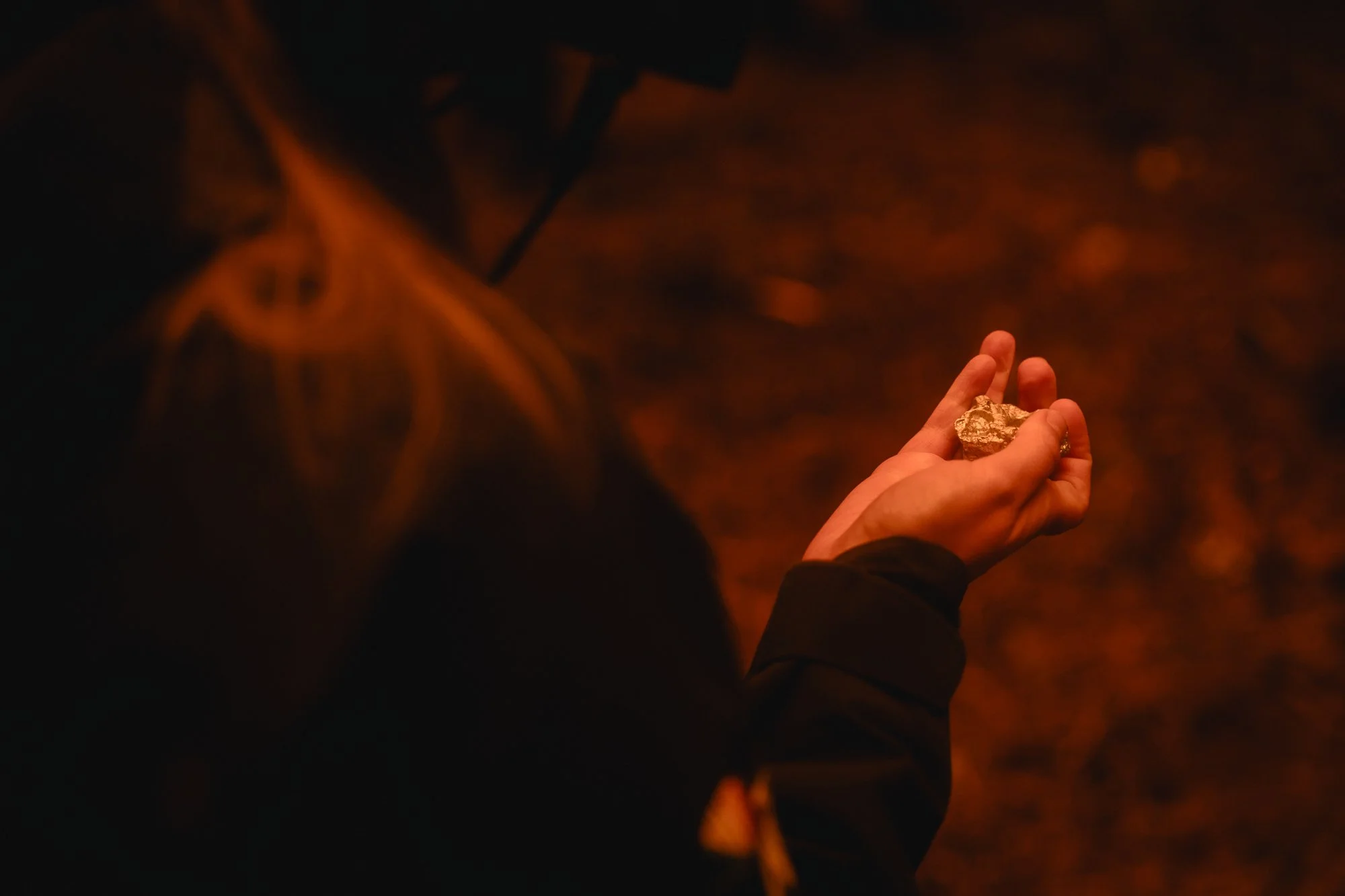
The rocks with the holes were collected from our pockets and were placed on this suspended sculpture. It was eventually spun by the performers, and would continue to spin, as the event concluded. It reminded me of the device at the end of Contact actually, which transported Jodie Foster to see her deceased father, but without the Hollywood budget.
Was the sculpture a spaceship to take us back? A portal to another dimension? A religious icon?
Solaris? was as much a dance piece as it was performance art. It was physical theatre. It was a sculpture park and an installation. It was a soundpiece and a light work. It was a moving image work and a nice walk in the park. An interactive audiobook maybe? There was something of the open world computer game in this too, wearing a lo-fi AR-headset, and heading off to explore.
My only criticism would be the choreography towards the end. As we dwelled too long, momentum and good will was being killed in the light drizzle. The performers, intense and panting, began with technical precision and attention to detail, but after the umpteenth repetition, the movements were unremarkable. This repetition of movements—and movement becoming less impressive with every action—was simply not as exciting to watch as the other elements of the performance.
It must be mentioned, all technical aspects of the performance were exceptional (the syncing of the sounds in our ears to what was going on around us, the changing filters over our eyes, the glowing sculptures pulsing on and off). The headsets were particularly nice, as while they could easily have become gimmicky, the usage of the filters was restrained, and the effect of these changing tonal fields created an extra level of (needed) alienation between the viewer and the site.
This effect of making the everyday alien or weird to me was the key to this performance. For a brief moment, on a slightly overcast summer evening, this natural environment was stranger; a vast amount of details in the landscape in this part of Tromsø were being taken in by my senses in ways they had never been before. In addition, it allowed different artistic forms ( sculpture, sound, performance) to compliment one another, working towards a cohesive whole. All in all, it was both a truly fine tribute to, and imaginative retelling of, Solaris.
Footnotes:
1: This film can be watched for free on Youtube. “Stalker” is usually considered his best film.